AI Digital Asset Management: How to Add AI Search Without Governance Risk
- Why AI exposes a weak DAM structure rather than creating the risk on its own
- How metadata inconsistency, weak permissions, and disconnected workflows scale under AI
- What an AI-ready DAM foundation looks like in practice
- How governed AI search speeds up discovery without losing control
How does AI improve digital asset management?
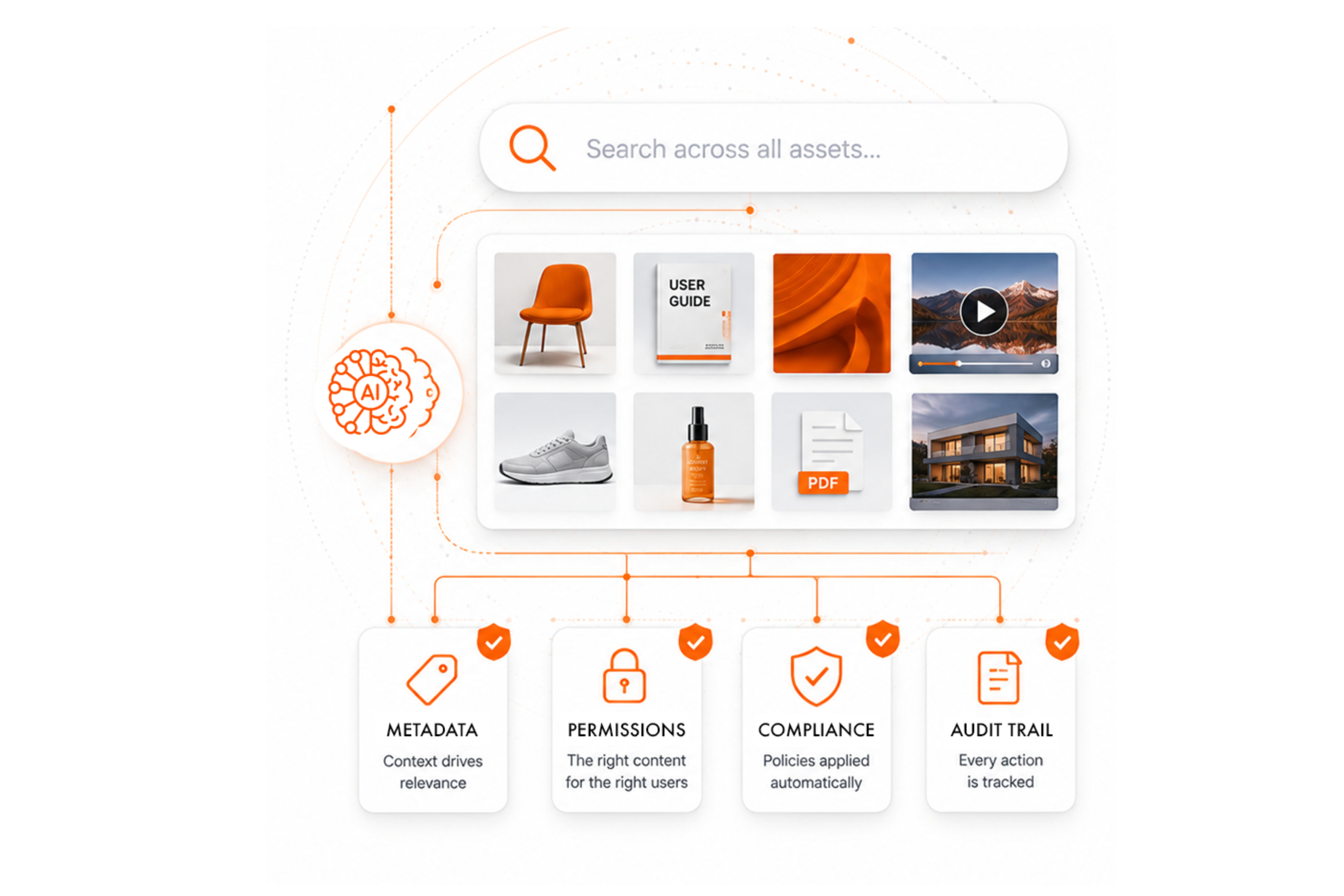
AI improves digital asset management by making large asset libraries faster to search and enrich: it auto-tags assets, transcribes speech, identifies visual patterns, and supports natural-language search across images, video, audio, documents, and campaign assets. Those gains hold only when AI runs inside the DAM's existing metadata schema, permissions, rights data, and workflows. Where that structure is weak, AI scales the problem instead of solving it.
Quick answer: What is AI digital asset management?
AI digital asset management is the use of AI — auto-tagging, transcription, and natural-language search — inside a governed DAM, so that AI enrichment and discovery operate using the same metadata schema, permissions, rights data, and workflows that already control the content. AI makes a large asset library faster to search, but only when the underlying structure is sound. When structure is weak, AI only scales the size of the problem.
Does AI in a DAM trade search speed for governance?
No. The real choice is not speed versus governance, it is speed with structure. Search matters because trust in the DAM depends on it. When users cannot find what they need, they stop searching, recreate work, ask another team, or pull files from an old folder.
AI reduces that friction by improving discovery across images, video, audio, documents, and campaign assets. It identifies visual patterns, suggests tags, transcribes speech, and supports natural-language search. For teams managing thousands or millions of digital assets, that speed changes how people experience the system.
The risk is governance drift. Tags start to vary by region, brand, or team. Assets surface in search even when permissions should prevent access. Rights restrictions sit in a contract, spreadsheet, or legal note instead of structured metadata the system can enforce.
AI does not create governance risk in DAM. It exposes it and scales it.
That distinction is the whole point. Inconsistent taxonomy means AI applies inconsistent labels at higher volume. Unclear approval paths mean AI may enrich or surface assets before they are ready. Rights data that is not attached to the asset means faster discovery raises the odds that someone uses restricted content. The fix is to keep AI inside the same permission model, approval logic, and rights governance that already protect the business.
Is AI in DAM a feature or a system test?
AI in DAM is a system test, not a feature layer. It reveals whether metadata, permissions, workflows, and rights data hold up once automation runs at scale.
AI is often evaluated as a checklist:
- Can the DAM software auto-tag images?
- Transcribe video?
- Support natural-language search?
- Suggest related assets?
Those questions matter, but they come too late if the system underneath is not ready.
That is where teams actually get stuck. In a Forrester Consulting study commissioned by Orange Logic, 58% of 313 global DAM decision-makers named creating an effective AI integration strategy their top challenge to achieving their DAM goals, well ahead of limited budget or lack of IT support, each cited by only about a quarter (Reimagining DAM for the Modern Enterprise, January 2026).
This mirrors broader AI-governance guidance. The NIST AI Risk Management Framework frames trustworthy AI as something organizations manage across the design, development, use, and evaluation of AI systems rather than a single feature decision.
In a DAM, that means AI needs clear inputs:
- Structured metadata tells the system what an asset is, who it is for, how to categorize it, and what context matters.
- Controlled vocabularies reduce inconsistent terms.
- Connected workflows show whether an asset is in review, approved, expired, localized, archived, or ready for distribution.
Treated as a bolt-on, AI creates a parallel logic outside the operational system. Users see AI tags that do not match the approved taxonomy. Search ranks relevance without enough context about permissions, rights, or approval status. Admins struggle to explain why certain results appear. A stronger model puts AI inside a unified content orchestration platform, where assets, metadata, permissions, workflows, integrations, and rights data support the full content lifecycle. That way, AI works from a governed context, not around it.
Why does AI break down without a structured DAM foundation?
AI breaks down when the foundation beneath it is weak in three specific places: metadata, permissions, and workflow.
- Metadata inconsistency scales first. A single inconsistent tag is a minor annoyance when applied by hand. At AI scale, it becomes a system-wide search problem. One team tags assets "product launch," another "launch campaign," another by regional convention. AI makes those assets easier to find, but without a controlled vocabulary or metadata schema to guide the output, it reinforces the inconsistency at volume.
- Permission control breaks second. AI can make discoverability outpace access rules when search is not deeply tied to permissions. A user may be unable to download a restricted asset, yet if it appears in search with a visible preview, metadata, or usage context, the organization still has an exposure issue. Security groups now track this pattern directly: the OWASP Top 10 for LLM Applications (2025) lists sensitive-information disclosure, excessive agency, and vector-and-embedding weaknesses. All of these argue for designing AI around access, context, and control.
- Workflow separation breaks third. AI may tag or route content, but if those outputs are not tied to approval stages, rights data, and distribution controls, teams still review manually outside the system. That reintroduces the email threads, spreadsheets, and side-channel approvals the DAM was meant to remove.
None of these are arguments against AI. They are arguments for better structure. When AI reveals missing metadata, unclear permission logic, or disconnected approvals, that feedback is useful. It shows where the operating model needs to mature before automation expands. The business outcome is compounding: fix the structure AI exposes, and every downstream search, reuse, and approval gets faster and safer.
Does better AI search remove the need for metadata?
No. Better AI search raises the bar for metadata quality, it does not replace it. Embeddings and semantic search surface what is relevant; structured metadata and rights data determine what is usable. A vector match can return a visually perfect asset that is expired, out of territory, or never approved.
This is the layer many AI-search projects skip. The strongest content operations connect the sequence end to end: content exists, metadata gives it structure, embeddings make it searchable by meaning, governance makes it trustworthy, and AI agents keep it healthy over time. Each layer depends on the one before it. The business outcome is search that returns not just the closest asset, but the closest asset a team is actually cleared to use.
What does an AI-ready DAM look like?
An AI-ready DAM needs enough structure for AI to produce useful outputs and enough governance for teams to trust them, not perfect data. Four layers make it work.
|
Layer |
What it provides |
What "AI-ready" requires |
|---|---|---|
|
Metadata |
Tells AI what an asset is and how to categorize it |
A defined schema (required, optional, inherited, conditional fields) plus controlled vocabularies for campaign, product, region, audience, asset type, rights status, and channel |
|
Permissions & rights |
Control who sees and uses each asset |
Granular permissions to view, edit, approve, download, distribute, or archive; rights data attached in structured fields: license terms, consent status, expiration, territory, embargoes, usage limits |
|
Workflow |
Turns AI suggestions into trusted operational data |
Routing into staging areas, required metadata before approval, review triggered by asset type or rights status, distribution gated until the right stage |
|
Admin control |
Keeps the system adaptable and auditable |
Trained admins can adjust fields, queues, permissions, vocabularies, and business rules without a developer or vendor ticket |
This is how the Orange Logic enterprise DAM platform is designed: AI enrichment, metadata governance, permissions, rights management, and workflow controls work as a single system rather than separate layers. Rights data is held in structured fields — territory restrictions, temporal windows, channel limits, and usage tracking — so the system can answer the questions that decide whether content is safe to use:
- Is this asset approved for this channel?
- Can it be used in this region?
- Has the license expired?
- Are there talent or partner restrictions?
Three design choices keep AI trustworthy inside that system:
- Source assets stay immutable and every AI action is written to an audit trail, so enrichment is reversible and reviewable.
- AI tags carry confidence scores, so low-certainty output is flagged for review instead of published silently.
- And no customer content is used to train the underlying models, so enrichment never leaks one client's assets into another's results.
Agent Studio lets teams build AI agents that route assets into staging, require metadata before approval, and hold distribution until rights clear; each agent operates inside human-defined permissions and rights rules, not around them.
This is also where enterprise digital asset management differs from a simple asset library: the value is not storage or faster search, it is coordinating ingestion, enrichment, review, approval, reuse, distribution, and archiving in one governed operating layer. The business outcome is faster discovery with fewer rights exceptions and less tag-correction rework. Reuse goes up without adding compliance risk.
How do you make AI search trustworthy?
You make AI search trustworthy by measuring whether it returns the right asset, in the right context, with the right usage rules attached.
That requires measurement. Track whether AI search improves findability, reuse, and workflow speed without increasing correction work or the number of rights exceptions. Reporting and analytics show:
- Which assets get used
- Which search terms fail
- Where users abandon workflows
- Where metadata or taxonomy needs refinement
Trustworthy AI search also benefits from a formal operating model. ISO/IEC 42001:2023 defines an AI management system for establishing policies and procedures around AI governance, risk management, and continuous improvement. The same mindset applies in a DAM: define how AI is introduced, monitored, corrected, and expanded. The business outcome is search teams can trust: AI that measurably improves findability and reuse while the number of rights exceptions and manual corrections goes down, not up.
How do you evaluate the best AI DAM tools?
Start with the outcome, not the AI demo, then check whether the tool can use your metadata schema, permission model, rights fields, and workflow status to shape its results. Use these criteria:
|
Criterion |
What to check |
Why it matters |
|---|---|---|
|
Metadata fit |
Can AI read and write your schema and controlled vocabularies? |
AI tags stay consistent instead of creating a parallel taxonomy |
|
Permission awareness |
Does search respect role-based access, including previews and metadata? |
Discoverability never outpaces access rules |
|
Rights enforcement |
Are license, territory, expiration, and consent held in structured fields? |
Faster discovery does not surface restricted content |
|
Workflow integration |
Do AI outputs tie to approval stages and distribution gates? |
Suggestions become trusted operational data, not manual rework |
|
Admin adjustability |
Can trained admins change fields, rules, and vocabularies without a developer? |
The system scales and stays auditable as the business changes |
|
Correction & confidence |
Can users flag low-confidence tags and refine vocabularies over time? |
Small metadata problems don't become recurring search problems |
How do you start building AI search on a governed foundation?
Start with one search problem that matters, then define the guardrails before scaling :
- Choose a use case
- Confirm the metadata standard
- Map permissions
- Connect rights data
- Set workflow gates
- Decide how AI outputs will be reviewed
First-party evidence backs the sequence. In one Orange Logic case study, a regulated organization cut tagging time by 70% by training AI on trusted existing metadata rather than an ungoverned dataset. The result was not accidental: the team started from a governed metadata base, so AI enrichment scaled with confidence that outputs would reflect the taxonomy, permissions, and rights rules already in place.Pearson followed that pattern: in its Orange Logic system, AI metadata tags made millions of assets discoverable and auto-captions were applied as searchable metadata, so general users could finally find material without knowing the publication year or ISBN (Pearson case study).
FAQs
What should teams look for in AI tools for managing marketing content in a DAM?
Start with the outcome, not the feature. If the goal is better search, check whether the tool can use your metadata schema, permission model, rights fields, and workflow status to shape results. Strong AI tools also let admins review and adjust outputs. That way, AI-generated tags, summaries, and recommendations support brand, campaign, region, and product context instead of forming a separate tagging layer.
How do you evaluate the best AI-powered DAM tools for governance and scalability?
Look past the AI demo and ask how the system handles:
- controlled vocabularies
- required metadata
- role-based permissions
- rights data
- approval routing
- audit history
- integrations with other enterprise systems
What defines the best DAM tools with AI features for enterprise content operations?
The best DAM tools with AI features connect AI to the full content lifecycle, not just tagging after upload. They help assets move through ingestion, enrichment, review, approval, reuse, distribution, and archive with governance intact. For enterprise teams, the deciding factor is usually operational fit: AI should work with existing:
- creative tools
- project management
- content management
- product information management
- partner portals
- archives
- delivery channels
How do DAM tools with AI tagging keep metadata accurate at scale?
AI tagging stays accurate when it operates within a defined metadata strategy:
- clear field rules
- controlled vocabularies
- taxonomy governance
- confidence thresholds
- review workflows for uncertain results
The system must also make corrections easy. If users cannot fix bad tags, flag low-confidence outputs, or refine vocabularies over time, AI turns small metadata problems into recurring search problems.
What governance considerations matter most when selecting AI-enabled DAM tools?
The most important considerations are permissions, rights, auditability, workflow control, and admin visibility. AI should never make restricted assets easier to expose, approved assets harder to verify, or metadata harder to govern. Teams should also weigh AI extensibility: mature programs may build AI agents to auto-tag, route, stage, pre-approve, publish, or enforce usage rules. Those agents should operate inside human-defined workflows, permissions, and rights rules instead of replacing them.
The takeaway
AI digital asset management works when AI operates inside the DAM's governance model, not around it. AI does not create governance risk; it exposes and scales whatever structure already exists. Get metadata, permissions, rights data, and workflow right first, and AI search becomes faster and more trustworthy. Start with one search problem, set the guardrails, then scale.
