What is a Digital Asset Management (DAM) System?
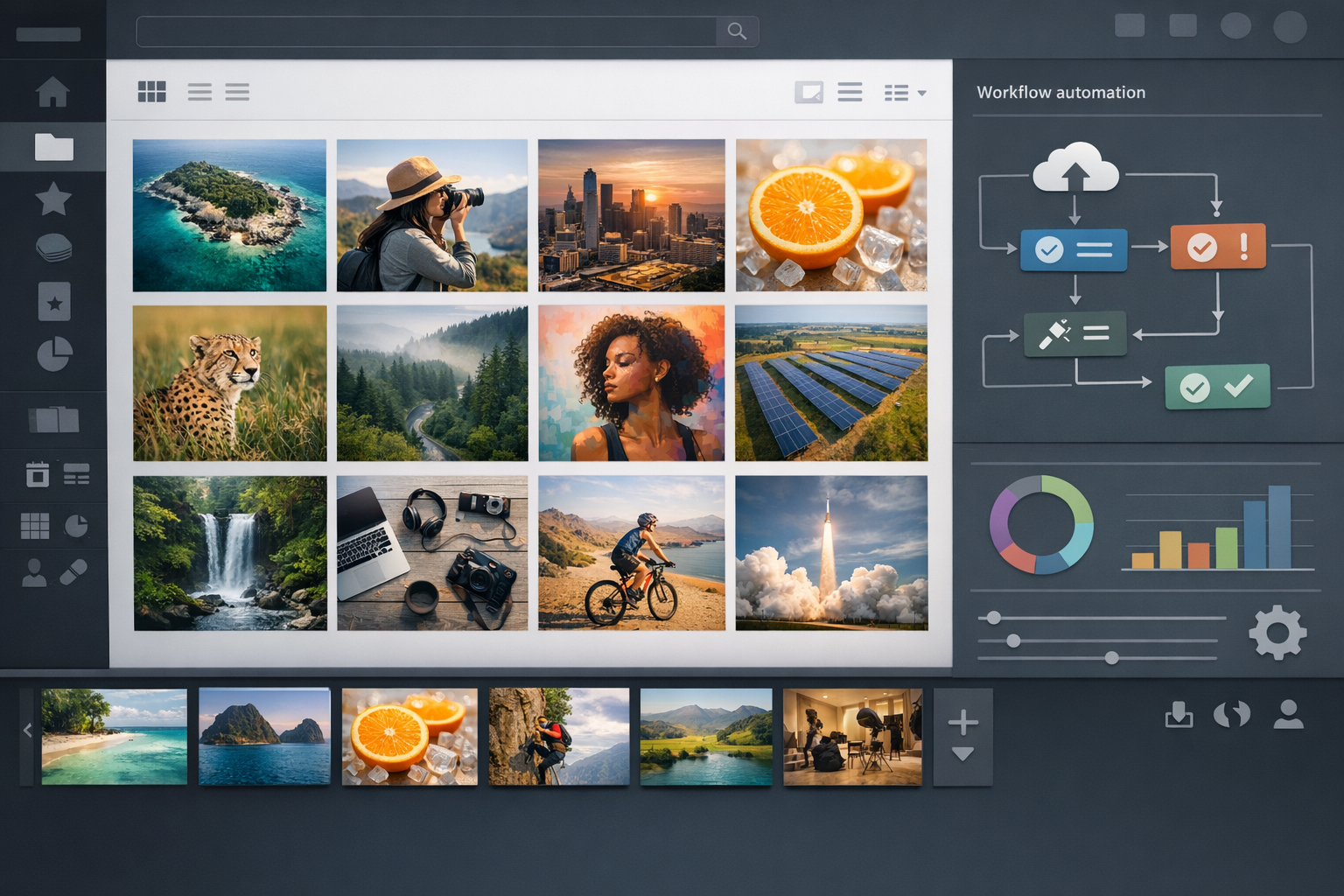
A DAM system is a centralized software system that stores, organizes, governs, and distributes an organization's digital assets — images, video, documents, and other multimedia files — from one searchable source of truth. Also called digital asset management software, it combines metadata, search, permissions, version control, and workflow automation so the right people can find and use the right asset without duplicating work or losing track of what's approved.
The term "DAM system" emphasizes the “system” dimension: not just a place to store files, but a system that connects to the tools teams already use and manages assets across their full lifecycle, from ingestion and tagging through review, distribution, and archival.
Why is a DAM system important?
A DAM system matters because it turns a scattered, hard-to-govern pile of files into an organized, searchable, and controlled library that scales as content volume grows. Without one, assets live across shared drives, cloud folders, inboxes, and desktops, where they are easy to duplicate, hard to find, and impossible to govern consistently. DAM systems provide:
- Centralized storage: One repository holds every asset, so nothing is duplicated, misplaced, or lost across disconnected systems.
- Enhanced collaboration: Shared, permission-controlled access lets internal teams, agencies, and partners work from the same current files instead of trading copies.
- Improved efficiency: Automating metadata tagging, versioning, and approvals removes manual effort and speeds up production.
- Brand consistency: Governed access to approved, on-brand assets keeps the right content in the right context across every channel.
- Compliance and rights management: Built-in controls track usage rights, licenses, and permissions, keeping asset use inside legal and contractual limits.
What are the key features of a DAM system?
The key features of a DAM system are the capabilities that make a large library findable, governable, and reusable. Most systems combine the following.
- Metadata management: Descriptive, administrative, and technical metadata tag and categorize each asset so it can be searched and retrieved.
- Search and retrieval: Keyword, metadata, and increasingly AI-powered search surface the right asset from a library of any size.
- Version control: Revision tracking keeps a single current version and preserves the history behind it.
- Access controls: Role- and permission-based rules restrict who can view, edit, and distribute each asset.
- Workflow automation: Automated review, approval, and publishing steps move projects forward without manual handoffs.
- Rights and permissions management: Usage rights, licenses, and expiration dates are tracked and enforced against how assets are used.
- Integration capabilities: Connections to creative tools, CMS, PIM, and marketing systems let assets flow into every downstream channel.
- Analytics and reporting: Usage, performance, and ROI reporting show how assets are used and where to optimize.
DAM system vs. cloud storage vs. CMS: what's the difference?
A DAM system is not the same as cloud storage or a content management system, though the three are often confused. A DAM system governs and activates digital assets; cloud storage (such as Google Drive or SharePoint) simply holds files; and a CMS publishes content to a website. The table below summarizes the distinction.
|
Dimension |
DAM system |
Cloud storage (Drive, SharePoint) |
CMS (Content Management System) |
|---|---|---|---|
|
Primary purpose |
Store, organize, govern, and distribute digital assets |
Store and sync files |
Create and publish web content |
|
Core strength |
Rich metadata, search, rights, and version control |
Low-cost file storage and sharing |
Page authoring, templates, and publishing |
|
Governance |
Role-, asset-, and field-level permissions; rights enforcement; audit trail |
Basic folder-level sharing permissions |
Publishing roles and workflow |
|
Typical users |
Creative, brand, marketing, and asset-management teams |
Anyone in the organization |
Web and content teams |
|
Answers the question |
Which approved asset do I use, and can I? |
Where is this file saved? |
Where does this content get published? |
For a fuller comparison of neighboring systems, see PIM vs DAM vs CMS: what's the difference?. In practice, these systems are complementary: a DAM system often acts as the governed media layer that a CMS and other channels draw approved assets from.
Who uses a DAM system?
A DAM system is used by any organization that produces, manages, and distributes a growing volume of digital content across teams and channels. It becomes essential at the point where manual, folder-based processes stop being reliable. How it’s used differs by role:
- Marketing and brand teams: to keep campaigns on-brand and reuse approved assets across channels.
- Creative and production teams: to manage source files, versions, and review-and-approval workflows.
- DAM and library administrators: to maintain metadata standards, permissions, and the health of the library.
- Legal and compliance teams: to track usage rights, licenses, and talent releases while reducing risk.
- IT and solution architects: to govern access, security, and integrations across the content stack.
DAM systems are common in media and entertainment, consumer brands and retail, higher education and cultural institutions, financial services, and any enterprise managing large libraries of photography, video, and marketing collateral.
How do you implement a DAM system?
Implementing a DAM system is a phased process, not a one-day setup. The upfront configuration ensures the system fits the ways an organization actually works. Most rollouts follow four steps:
- Needs assessment: Identify requirements such as storage scale, user roles, metadata needs, and integrations, then use them to select the right system.
- Customization: Configure metadata schemas, taxonomies, permissions, and workflows, and integrate with existing systems.
- User training: Train users on core features, metadata practices, and workflows so adoption sticks.
- Ongoing maintenance: Keep the system secure and current with software updates, access reviews, and regular audits.
What are the challenges and best practices of a DAM system?
The main challenges of running a DAM system are user adoption, metadata consistency, scalability, and security. Each has an established best practice:
- DAM Challenge: User adoption:Adoption can lag if the system feels like extra work.
- User adoption best practice: Training, clear benefits, and a genuinely usable interface raise adoption rates.
- DAM Challenge: Metadata consistency: Inconsistent tagging breaks search.
- Metadata best practice: Standardized metadata templates and controlled vocabularies keep tagging reliable.
- DAM Challenge: Scalability: Asset volume only grows.
- Scalability best practice: Choosing a system with scalable infrastructure protects long-term viability.
- DAM Challenge: Security: Assets need protection from unauthorized access.
- Security best practice: Strong access controls, encryption, and regular security audits safeguard the library.
How Orange Logic delivers a DAM system
Orange Logic is an enterprise DAM system built to be the single system of record for content across an entire organization; the system teams grow into instead of out of. Where many DAMs manage the asset library and stop there, Orange Logic adds the governance and agentic layer above it. It is a Leader in both the Forrester Wave: Digital Asset Management (Q1 2026) and the Gartner Magic Quadrant for Digital Asset Management Platforms (November 2025).
- Find: AI-powered search understands what an asset is, not just what it's named, and returns the right file from a library of any size. Agentic AI goes further: agents act on your governed content to keep tagging, metadata, and delivery moving without manual effort. Orange Logic earned Forrester's top score of 5.00 for search in the Q1 2026 DAM Wave.
- Govern: Permissions reach the role, group, asset, and individual metadata field, with a tamper-proof audit trail of every action.
- Adapt: A no-code workflow builder and curated Spaces let each team shape its own view and workflow on one shared system. Forrester scored Orange Logic 5.00 for workflow automation.
- Protect: Usage rights are enforced at the point of use, not just stored, with alerts before licenses lapse. Forrester scored Orange Logic 5.00 for digital rights management.
- Grow: The system runs proven at tens of millions of assets; A+E Global Media manages 754,125 photographs across 202 territories on Orange Logic.
The business outcome is one governed system that scales from one team to the enterprise without a re-platform: teams find assets faster, enforce rights automatically, and retire the point tools they were paying for separately.
To see how a DAM system would work with your own assets, book a demo.
Frequently asked questions
What is the difference between a DAM system and cloud storage?
Cloud storage (such as Google Drive or SharePoint) stores and syncs files; a DAM system adds rich metadata, powerful search, version control, usage-rights tracking, and granular permissions on top. Storage answers "where is this file saved?"; a DAM system answers "which approved asset do I use, and am I allowed to?"
Is a DAM system the same as a CMS?
No. A DAM system stores and governs the assets themselves; a CMS (Content Management System) publishes content to a website. They are commonly integrated: the DAM supplies approved media and the CMS publishes it.
Can a DAM system manage video, not just images?
Yes. Modern DAM systems manage video and audio natively alongside images and documents, with media-specific features such as scene-level indexing, previews, and streaming of large files. This keeps a photo library and a video archive in one system of record.
Does a DAM system use AI?
Yes. AI is core to modern DAM systems today. It powers semantic and visual search, auto-tagging on ingestion, and, in more advanced systems, agents that act on governed content to automate tagging, metadata, and delivery. AI works best on a DAM's governed, well-described assets, which keep the output accurate and auditable.
How much does a DAM system cost?
Enterprise DAM systems are typically priced by scale — library size, number of users, and the modules turned on — rather than a flat per-seat price, so a real number starts with the use case. The business case usually builds from time saved finding and re-creating assets, reduced rights risk, and retiring the point tools a DAM system replaces.
Summary: What is DAM System?
A DAM system is a vital system for any organization that needs to manage digital assets at scale. By centralizing storage, enabling collaboration, governing access, and automating workflows, it keeps content organized, findable, and used correctly across every team and channel. While implementing one takes planning, configuration, and ongoing maintenance, the payoff in efficiency, brand consistency, and compliance makes it a worthwhile investment. As digital content keeps growing in volume and importance, the DAM system becomes the foundation the rest of an organization's content operations are built on.
