Why download the guide?
You send your RFP to five vendors, and every response comes back a wall of confident yeses. Your scoring spreadsheet shows five near-identical totals, the shortlist comes down to demo polish, and the differences that actually decide the next decade (the ones your team discovers six months after go-live) never surface at all.
The cost of that is measurable: only one in three software buyers gets through purchase and implementation without disruption or regret, and 44% of those who don't end up switching to a different vendor's product. (G2)
A good RFP is not a longer list of questions. It is a sharper set of questions, paired with the knowledge of what a strong answer looks like. This guide gives you both.
What's inside
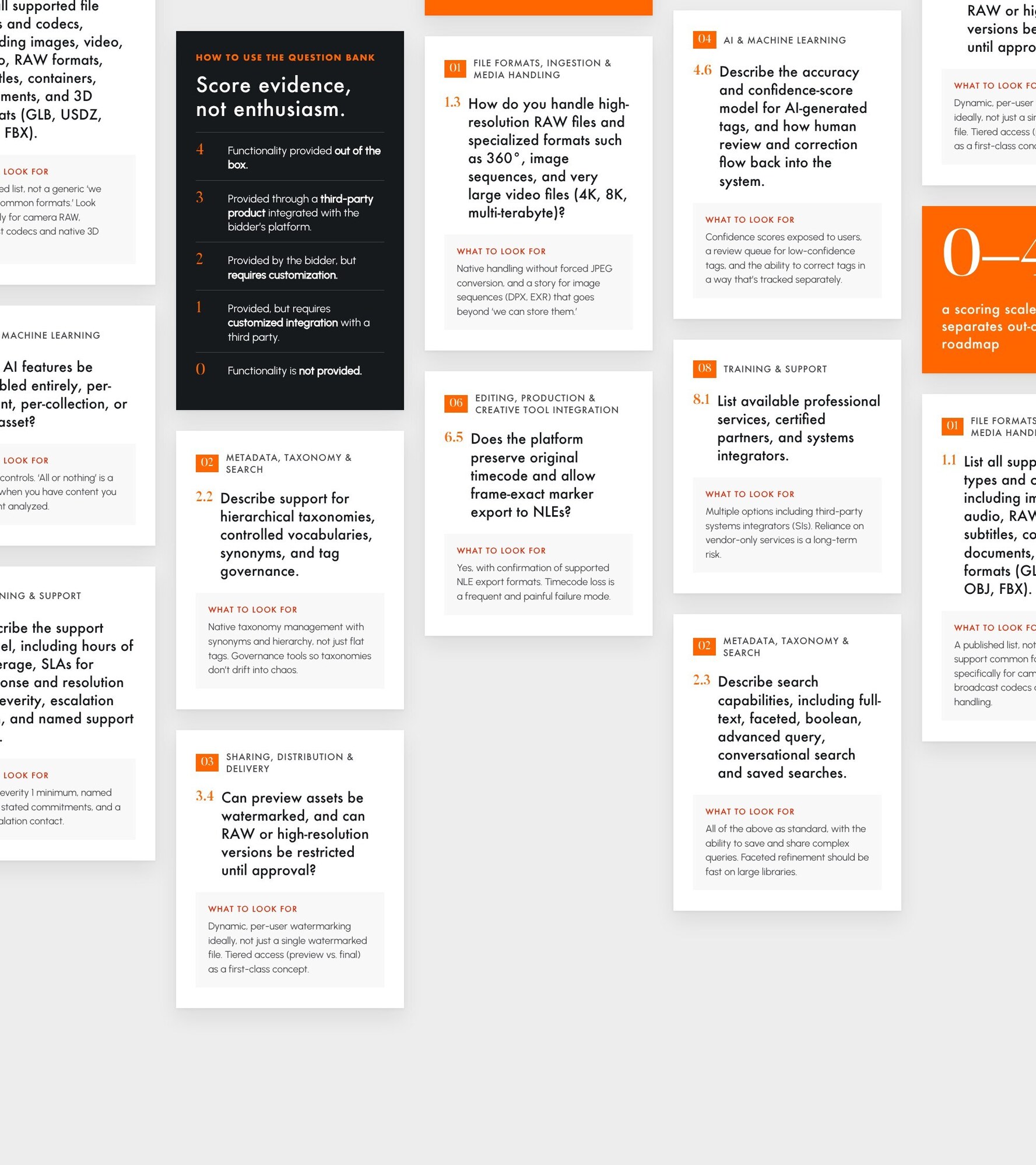
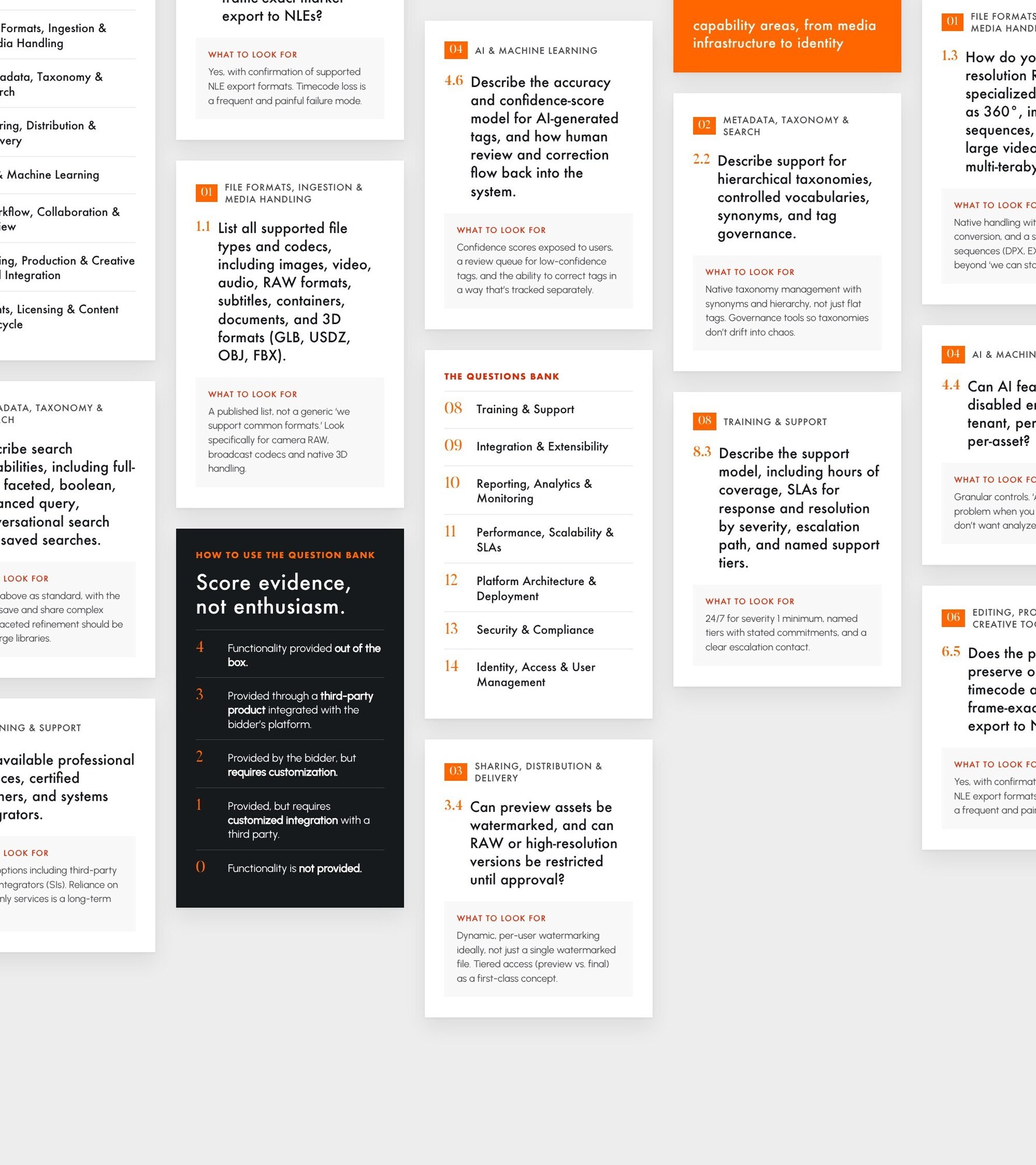
- 79 questions across 14 capability areas, all written as observable behavior that can’t be answered with adjectives.
- Evaluator guidance on every question: what a credible answer contains, and which patterns deserve a second look.
- A zero-to-four scoring scale that separates capabilities that ship out of the box from those that need a services team or are on next year’s roadmap.
- A guide to reading the comments column, detailing the four phrases that signal a recurring cost, a second vendor relationship, or a capability that doesn’t exist yet.
- The questions best settled in a proof of concept, run against a deliberately messy batch ingest, your largest video files, your real taxonomy, and your worst permission edge case.
The guide also includes a ready-to-send scoring workbook, pre-formatted for vendor responses with the scale built in. Take the guide, cut the sections that don't apply, reorder it to match your priorities, and make it yours.
Who we work with


















Who we work with





“We were using multiple systems that each only served one function and didn’t talk to one another. With Orange Logic, we were able to centralize all of those workflows into one place. Turns out, one size really does fit all!”


“I could just sit here all day and list off all the things that Orange Logic is allowing us to do that we previously have never been able to.”


WAVE LEADER 2026
DIGITAL ASSET MANAGEMENT SYSTEMS