PIM vs DAM vs CMS: What's the Difference?
PIM vs DAM vs CMS: a PIM manages product data, a DAM manages digital assets, and a CMS publishes web content. See how the three differ and work together.

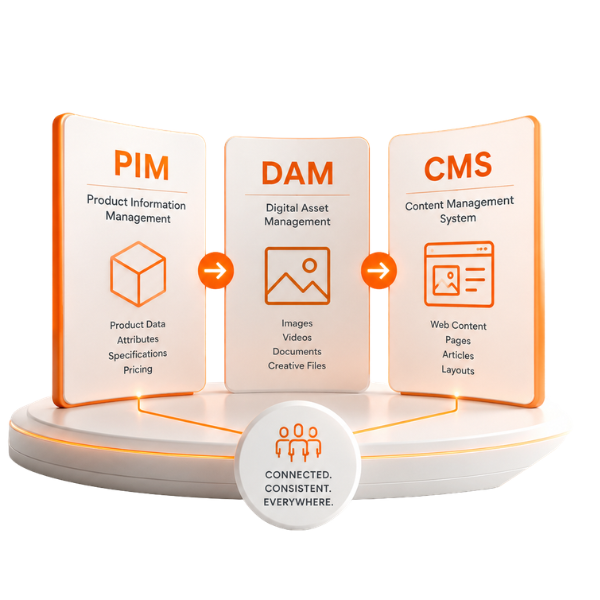
PIM, DAM, and CMS are three distinct systems that manage different parts of an organization's content and product information. A PIM (Product Information Management) system is the source of truth for product data; a DAM (Digital Asset Management) system is the source of truth for rich media and creative files; and a CMS (Content Management System) is the platform used to publish digital content, most often a website. They are frequently confused because all three "manage content" and often connect to one another. However, each answers a different question: what is the product? (PIM), what does it look like? (DAM), and where do people see it? (CMS).
What is a PIM (Product Information Management)?
A PIM is a system that centralizes, enriches, and distributes product information, such as descriptions, specifications, SKUs, attributes, pricing, and categorization, so that consistent product data can flow to every sales and marketing channel.
PIM systems are most common in retail, ecommerce, manufacturing, and distribution, where a single product may need slightly different information for a website, a marketplace, a printed catalog, and a sales team. Instead of maintaining that data in spreadsheets or in each channel separately, a PIM keeps one authoritative record and syndicates it outward.
Typical PIM capabilities include:
Centralized product records: One source of truth for every product attribute
Data enrichment and quality: Completing, validating, and standardizing product data
Categorization and attribute modeling: Organizing products into a structured catalog
Localization: Managing translations and region-specific product details
Channel syndication: Pushing product data to ecommerce platforms, marketplaces, and catalogs
Workflow and governance: Controlling who can edit and approve product information
A PIM typically integrates with an ERP system (which holds operational and pricing data), ecommerce platforms, marketplaces, and a DAM, which supplies the images and videos that accompany each product record.
What is a DAM (Digital Asset Management)?
A DAM is a system that stores, organizes, and distributes digital assets, such as images, videos, audio, documents, and creative source files, using metadata, search, permissions, and version control so that the right people can find and use the right asset.
Typical DAM capabilities include:
Metadata and taxonomy: Tagging assets so they can be searched and filtered
Advanced and AI-assisted search: Finding assets by keyword, attribute, or visual content
Version control: Tracking revisions and keeping a single current version
Rights and permissions management: Controlling usage rights, licenses, and expiration
Renditions and transformations: Generating the right size or format for each channel
Distribution and portals: Sharing approved assets internally and with external partners
A DAM typically integrates with creative tools (for example, Adobe Creative Cloud), with a CMS that publishes assets to the web, and with a PIM that links product records to their associated media.
What is a CMS (Content Management System)?
A CMS is a system used to create, manage, and publish digital content, most commonly the pages of a website, without requiring the author to write code. It provides templates, an editing interface, and a publishing workflow so that non-technical users can build and maintain a site or digital experience.
Common examples of content management systems include platforms such as WordPress, Drupal, and Contentful. Some are "traditional" (content and presentation are coupled), while others are "headless" (content is delivered via an API to any front end).
Typical CMS capabilities include:
Content authoring: Creating and editing pages through a visual or structured editor
Templates and themes: Controlling layout and presentation consistently across a site
Publishing workflow: Drafting, reviewing, scheduling, and publishing content
Site and page structure: Organizing navigation, URLs, and content hierarchy
User roles and permissions: Governing who can author and publish
SEO and delivery: Managing metadata, performance, and multi-channel delivery (in headless setups)
A CMS typically integrates with a DAM (which supplies approved media for pages), a PIM (which supplies product data for commerce pages), analytics tools, and marketing or ecommerce platforms.
Why PIM, DAM, and CMS matter:
Each system solves a different failure that appears as an organization's content and product catalog grow:
Without a PIM: Product information lives in scattered spreadsheets and channel-specific fields, producing inconsistent, incomplete, or out-of-date listings across the website, marketplaces, and print.
Without a DAM: Creative files are spread across drives, inboxes, and folders. Files are hard to find, easy to duplicate, and prone to the wrong or expired version being published.
Without a CMS: Publishing and updating a website depends on developers, which slows down even routine content changes.
Together, these systems let teams manage the volume and complexity of modern content operations: accurate product data at scale, a governed library of reusable media, and the ability to publish quickly. They matter most as the number of products, channels, assets, and contributors increases, which is also when manual, ad-hoc processes stop being reliable.
PIM vs DAM vs CMS: key differences
The three systems overlap in that they all manage some form of content and are often connected in the same technology stack. They differ in what they manage, who uses them, and what they are for. The table below summarizes the distinctions.
|
Dimension |
PIM (Product Information Management) |
DAM (Digital Asset Management) |
CMS (Content Management System) |
|---|---|---|---|
|
Primary purpose |
Maintain one source of truth for product data and distribute it to every channel |
Store, organize, and distribute rich media and creative files |
Create, manage, and publish digital content, most often a website |
|
Type of data managed |
Structured product information: descriptions, specs, SKUs, attributes, pricing, categories |
Digital assets: images, video, audio, documents, design and source files |
Web and digital content: pages, articles, structured content, and their layout |
|
Typical users |
Ecommerce and product managers, merchandisers, product marketers, catalog teams |
Creative and brand teams, marketers, agencies, asset librarians |
Web teams, content editors, marketers, and developers |
|
Core capabilities |
Data enrichment, attribute modeling, localization, governance, channel syndication |
Metadata and search, version control, rights management, renditions, distribution |
Authoring, templates, publishing workflow, site structure, roles, SEO |
|
Typical integrations |
ERP, ecommerce platforms, marketplaces, DAM |
Creative tools, CMS, PIM, work-management tools |
DAM, PIM, analytics, marketing automation, ecommerce |
How PIM, DAM, and CMS work together
The clearest way to see the relationship is to follow a single product page on an ecommerce site:
- The PIM supplies the product's facts: name, description, specifications, price, and categorization.
- The DAM supplies the media: the product photography, lifestyle images, and video.
- The CMS assembles those inputs into a published page and delivers it to visitors.
Each system owns a different layer, and the page is only complete when all three contribute. In most implementations, the DAM often acts as the shared media layer that both the PIM and the CMS draw from: the PIM links product records to the approved images and video held in the DAM, and the CMS pulls those same governed assets onto the page. That arrangement keeps a single, current version of each asset in one place rather than copying files into each system, which is typically what allows product data, brand media, and published pages to stay consistent as they change.
The systems are complementary, not competing. Organizations rarely choose between a PIM, a DAM, and a CMS; more often they decide which they need first and how to connect them. A retailer with a large catalog may start with a PIM; a brand-heavy organization with a large media library may start with a DAM; nearly everyone with a public presence has a CMS. The value compounds when they are integrated.
FAQs
Is a DAM the same as a CMS?
No. A DAM (Digital Asset Management) system manages and governs a library of rich media — images, video, and creative files — so they can be found and reused. A CMS (Content Management System) manages and publishes digital content, most often web pages. They are commonly integrated: the DAM stores the assets, and the CMS publishes them to a site. Some CMS platforms include basic media libraries, but these typically lack a DAM's metadata, rights management, and version control.
What is the difference between a PIM and a DAM?
A PIM manages structured product information — descriptions, specifications, SKUs, and pricing — while a DAM manages digital assets, such as the images, video, and files that represent products and the brand. Put simply, the PIM holds the facts about a product and the DAM holds the media that shows it. In a connected stack, the PIM links each product record to the assets stored in the DAM.
Do I need all three systems: a PIM, DAM, and CMS?
Not necessarily. It depends on what you sell and how you operate. Organizations with large, complex product catalogs benefit most from a PIM; those with large media libraries and brand-consistency needs benefit most from a DAM; almost any organization with a website uses a CMS. Many organizations adopt them incrementally and integrate them over time rather than deploying all three at once.
Conclusion
PIM, DAM, and CMS are often mentioned together because they all manage content and frequently connect, but they are not interchangeable. A PIM manages product information, a DAM manages digital assets, and a CMS manages and publishes digital content. Understanding the distinction and how the three systems exchange data is the first step in designing a content and commerce stack that stays accurate, consistent, and fast as it scales. Rather than choosing one over the others, most organizations decide which to prioritize and then integrate them so that product data, brand media, and published experiences reinforce one another.
