
Last updated:
Why the cost of keeping products market-ready deserves as much attention as the speed of launching them.
A product can be ready to launch today and no longer be ready tomorrow. An ingredient changes, packaging is revised, or a retailer introduces a new requirement. The product may still be available for sale, but the information, imagery, and claims supporting it may no longer be appropriate for every market or channel.
For consumer goods companies managing thousands of products across multiple regions and retailers, the challenge isn't always making the change. It's understanding everything the change affects, coordinating what needs to happen, and confirming that the right product experience is available wherever consumers shop.
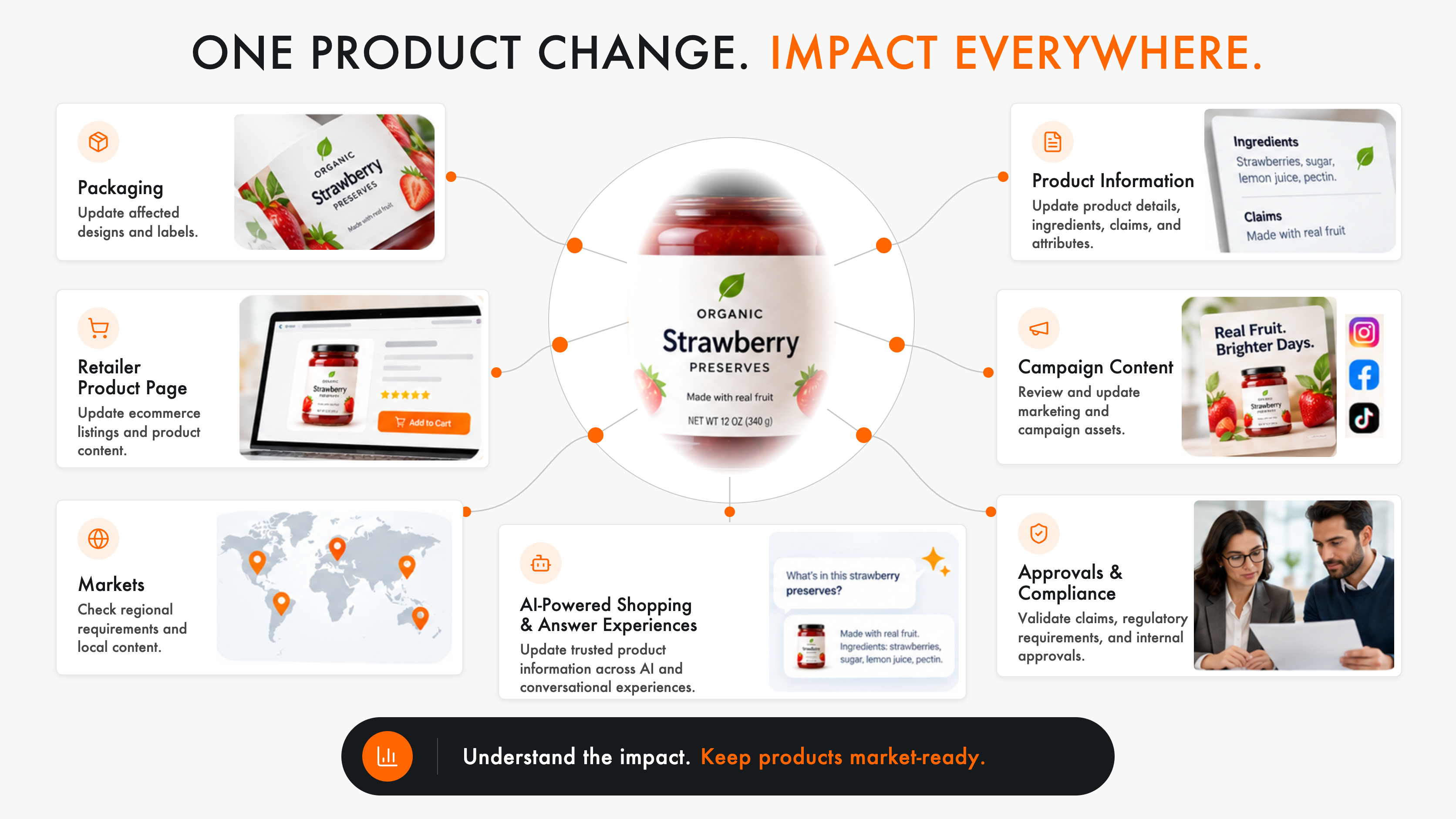
That work has an economic cost. It can delay a retailer expansion, make a regional launch more expensive, or consume resources that could otherwise support growth. Yet companies typically measure how quickly they bring products to market, not how much effort is required to maintain readiness afterward.
Time to market measures the launch. Change-to-ready time measures the business's ability to respond afterward. It is the elapsed time between approval of a product change and verified readiness across the destinations affected by it.
Reducing that time, along with the effort required to achieve readiness, could change which commercial opportunities a company can afford to pursue.
Having the Content Doesn't Mean You're Ready
Consider a food manufacturer updating the formula for an existing product. New specifications are approved, packaging is revised, and updated photography is produced. Internally, the work may appear complete, while retailer websites still display previous packaging or campaigns continue using outdated claims.
Research illustrates the gap between what manufacturers have available and what consumers actually encounter.
ChannelSight research reported by Salsify examined more than 500,000 manufacturer products across 50 retailers in 10 markets. Among the assessed products, 92% had at least two images and a video available in the manufacturer's product information management system, yet only 15% featured video on retailer product pages.
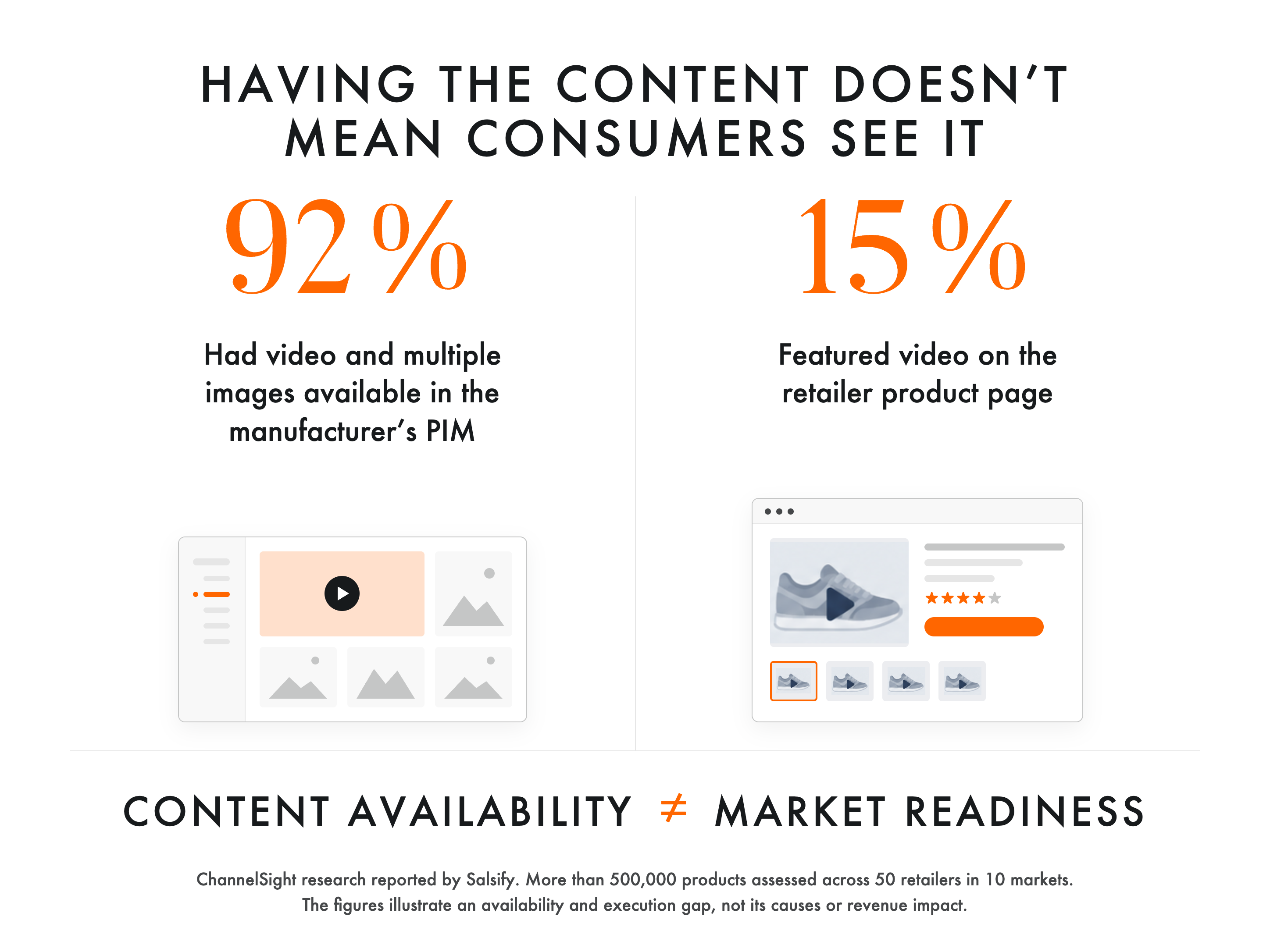
The research doesn't establish why individual listings lack video, but it illustrates an important distinction: investing in content and making that content available to consumers are different achievements.
A compelling product experience depends on three elements working together:
- Accurate product information establishes what is being sold.
- Compelling media helps consumers understand and evaluate it.
- Approved brand context determines which claims, versions, rights, and supporting materials are appropriate for each use.
Even when all three are available internally, the product may not be ready in market. Content can be prepared without being accepted by a retailer, or accepted without becoming visible to consumers. Brands need to distinguish those stages and understand where work remains incomplete.
The newest version isn't always the correct one, either. When old and new packaging coexist in the market, different retailers may legitimately require different approved versions during the transition. Readiness depends on the product version, destination, requirements, and effective date, not simply whether the latest asset has been distributed.
For manufacturers, the opportunity is to know which experiences are ready, which are waiting, and which require intervention before they affect consumers or commercial plans.
The Economics of Staying Market-Ready
The commercial opportunity becomes clearer when companies examine what happens between approving a product change and making it ready across the required destinations.
A packaging revision may take days to produce but weeks to reach every affected retailer and market. During that period, teams can spend considerable time checking status, resolving inconsistencies, repeating reviews, and recreating content that may already exist.
Deloitte's 2026 Global Consumer Products Industry Outlook found that 74% of surveyed companies are simplifying organizational structures to reduce interdependencies and improve decision-making. Yet making departments more efficient doesn't necessarily eliminate the delays and repeated work that occur between them.
Improving product readiness can create value in three ways:
- Reducing duplicated production and corrective work can lower avoidable costs.
- Eliminating unnecessary handoffs can recover capacity, allowing existing teams to support more product variations, retail partners, and campaigns.
- Making products commercially ready sooner can help companies capture selling windows or pursue opportunities that would otherwise be difficult to execute.
These outcomes should be measured separately. Change-to-ready time measures elapsed time, not cost. Companies should also measure the labor, external spending, and rework required to achieve readiness. A faster process is not necessarily more economical if it requires additional people or expensive manual intervention.
Likewise, recovered capacity doesn't automatically reduce spending, and earlier availability doesn't guarantee revenue. The value depends on what the business can accomplish with the resources and opportunities it gains.
This creates a different way to evaluate content investment. Before commissioning new creative, teams can determine whether suitable content already exists, whether it can be adapted, and whether the cost of producing something new is justified by the commercial opportunity.
The larger advantage isn't simply producing more content for less money. It's reducing the ongoing cost of keeping products market-ready, making additional growth opportunities economically practical.
AI Is Expanding What Market Readiness Requires
Product readiness is becoming more important as consumers use AI assistants to research, compare, and evaluate purchases.
A Gartner survey conducted in January 2026 found that 31% of surveyed U.S. consumers were willing to let AI narrow their choices for household supplies. Willingness to delegate final purchasing decisions was considerably lower, indicating that AI is already influencing product consideration while consumers retain control over what they buy.
This introduces a different test of readiness. A product may have complete specifications, descriptions, and imagery yet still lack the information needed to answer a consumer's question.
In its October 2026 analysis, Agentic Commerce Exposes the Missing Dimension in Product Data, Forrester explains that traditional product attributes often fall short when consumers ask about real-world applications, suitability, and outcomes.
Consider the food manufacturer's revised product. A shopper might ask an AI assistant whether the sauce can be used as a marinade or whether the new formula meets a specific dietary requirement. Answering reliably requires more than a product category or ingredient list. It may require approved preparation guidance, relevant limitations, and claims that reflect the correct product version.
For consumer goods companies, the opportunity is to make accurate product information, compelling media, and approved brand context ready for both traditional shopping channels and AI-powered experiences. Consumers still need engaging visual experiences, while AI systems increasingly need product knowledge that can support useful, accurate answers.
Brands cannot control every response generated by external AI services, but they can improve the relevance, accuracy, and accessibility of the information those services can use.
AI doesn't create an entirely separate content challenge. It raises the standard for what it means to be ready and makes incomplete or inconsistent product knowledge more consequential.
From Connected Systems to Coordinated Responses
Most large consumer goods companies already have platforms managing product information, creative production, digital assets, marketing, and commerce. Each plays an important role, but exchanging information between them doesn't necessarily help the business understand the consequences of a change.
Returning to the food manufacturer, an ingredient update could affect packaging artwork, product descriptions, marketing claims, regional variations, and retailer submissions. The business needs to identify which materials require updates, which remain valid, and which decisions require additional review.
An integration can move the new asset. The business still needs to understand what becomes outdated because of the change and what remains valid.
That requires maintaining the relationships between products, content, versions, approvals, rights, and commercial destinations. With this context, teams can make better decisions about whether to reuse existing materials, adapt an approved version, or initiate new production.
AI agents can increasingly assist by identifying gaps, recommending actions, and coordinating approved work across systems. Important decisions involving product claims, regulatory requirements, and usage rights still require appropriate human oversight.
Over time, information about content reuse, production costs, retailer requirements, and commercial performance could also improve future decisions. Instead of repeatedly reconstructing the same context, teams could use what the business has already learned to make the next change easier and less expensive.
The strategic opportunity goes beyond connecting platforms or automating individual tasks. It is to create a more coordinated business response, where changes are understood in context, appropriate actions follow, and each completed process contributes knowledge that improves the next.
Start With One Product Change
A practical way to evaluate this opportunity is to examine a recent packaging revision, ingredient change, or product launch that affected multiple teams and commercial destinations.
Trace the work from the original decision to verified market readiness. Establish when internal teams completed their responsibilities, when destinations accepted the updates, and when the intended experiences became available. Any unresolved exceptions should be tracked separately rather than counted as completed.
Measure change-to-ready time alongside the effort, external spending, and rework involved. The results may reveal duplicated production, unnecessary handoffs, delayed approvals, or incomplete information that adds cost without improving the consumer experience.
Then consider the commercial implications. If the next change required less coordination and expense, could the business support additional retail partners, introduce regional variations more economically, or execute more campaigns with its existing resources?
Launching new products is only part of the growth equation. The other is keeping the existing portfolio market-ready without multiplying the work required to support it.
For consumer goods companies, the next competitive advantage may come from making every product decision easier, faster, and more economical to put into market.
Orange Logic's strategic partnership with AWS helps Consumer Goods companies keep products market ready as requirements change. Combining Orange Logic's governed content and intelligent workflows with AWS infrastructure and AI helps teams reduce rework, accelerate launches, and deliver accurate product information, compelling media, and trusted brand experiences to consumers and AI agents at scale.
Reduce the Work Between Product Change and Market Readiness
Bringing product changes into market requires connecting the systems that understand different parts of the business. Salsify provides product information and commerce context, while Orange Logic provides governed digital content, versions, approvals, and asset relationships. Their existing integration supports the exchange of product information and assets.
Orange Logic's strategic partnership with AWS provides a cloud foundation for enterprise content operations, processing, delivery, and AI capabilities. Together, these technologies create opportunities to improve coordination across existing systems while establishing a foundation for more intelligent responses to business change.
Keep Your Portfolio Market-Ready Without Multiplying the Work
See how Orange Logic connects product information, approved content and brand context so your teams spend less time and money keeping products market-ready. Book a demo