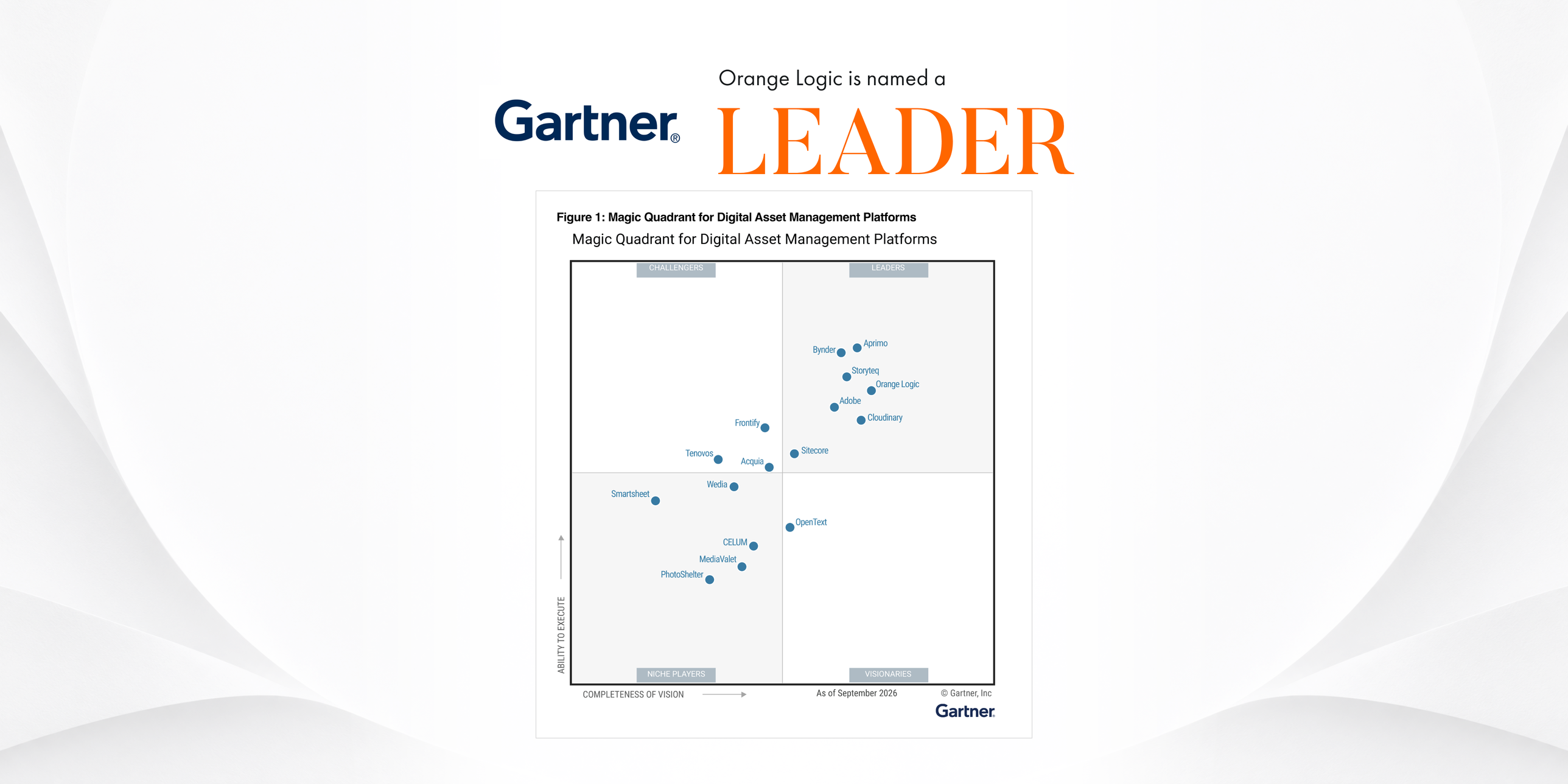
Orange Logic is named a Leader in the 2026 Gartner® Magic Quadrant™ for Digital Asset Management Platforms. As AI reshapes enterprise operations, DAM is becoming the foundation for how organizations manage, govern, and put content to work across their business.
A digital asset management system can be excellent at organizing content and still leave an enterprise struggling to use it.
Anyone who has managed content across a large organization knows the frustration. Finding an approved image might take seconds. Getting that same image into a global campaign can involve regional licensing rules, local adaptations, multiple approvals, external agencies, and business systems that weren't necessarily designed to work together.
The asset is there. The metadata is accurate. Everyone knows where to find it. Yet getting it into market remains frustratingly complicated.
AI is creating opportunities to change that. As organizations introduce assistants and agents into everyday work, they're looking for ways to reduce the manual effort surrounding content. But those tools need more than access to files. They need to understand what they're allowed to do with content, which business rules apply, and how to work with the systems surrounding it.
This is changing what enterprises should expect from DAM. The technology needs to support the work that happens before and after someone finds an asset, without adding another layer of complexity.
It's a challenge we've spent years working to address at Orange Logic, and one reason we're proud to have been named a Leader in the 2026 Gartner Magic Quadrant for Digital Asset Management Platforms.
The recognition comes at an important time for the industry, as enterprises reconsider the role DAM should play in their broader technology environment.
Enterprise scale shouldn't mean enterprise complexity
Supporting a global organization involves far more than managing millions of assets. Different brands have their own guidelines, licensing restrictions vary by market, and internal teams, agencies, and distributors all need access to the right content.
The challenge is making those requirements manageable without creating a separate process for every team or region.
A well-designed enterprise DAM should accommodate different business structures, metadata requirements, and permissions while giving people a consistent way to find and use approved content.
As organizations grow, they should be able to introduce new teams, applications, and workflows without continually rebuilding their content operations.
That's where the underlying architecture matters. Flexible metadata, configurable permissions, and reliable integrations may not be the most exciting parts of a product demonstration, but they make a considerable difference when thousands of people and multiple business systems depend on the platform every day.
For buyers evaluating DAM, it's worth testing these requirements against real scenarios. Bring the complicated licensing arrangements, global approval workflows, and large media libraries. Understand how the platform supports different business units and what administration looks like as requirements change.
AI needs the context surrounding an asset
AI has already made DAM more useful. Automated metadata, natural language search, object recognition, and transcription have reduced the time people spend organizing and finding content. These are meaningful improvements, particularly for teams managing large libraries.
But finding an asset is often the easiest part of a much larger process.
Consider a marketing team preparing a campaign across 20 countries. AI might identify suitable creative in seconds, but the team still needs to establish where it's licensed, whether the messaging is current, which adaptations are necessary, and what approvals are required before distribution.
That information isn't always contained in the file itself. Some comes from metadata and rights agreements. Other details depend on product systems, business rules, or the people responsible for approving the work. An AI assistant can retrieve a file without understanding any of those relationships.
For enterprises, the opportunity is to connect AI with the context and business processes that determine how content can actually be used.
Why bidirectional connectivity matters
Orange MCP operates as both an MCP server and client, allowing enterprise content and AI to work together in both directions.
External assistants such as ChatGPT, Claude, and Microsoft Copilot can securely access approved content in Orange Logic using existing permissions. Employees can work with governed assets in the AI tools they already use, without creating separate, uncontrolled copies or constantly switching applications.
The connection works in reverse, too. Orange Logic agents can interact with external enterprise systems, supporting content-related tasks that extend beyond the DAM.
This gives organizations more flexibility in how they introduce AI. They can make governed content available to their preferred assistants while allowing Orange Logic agents to work with other applications already in place.
That flexibility is important as AI technology continues to evolve. Enterprises shouldn't need to rebuild their content operations whenever they adopt a new model or application.
The benefit of bidirectional MCP is ultimately what those connections make possible: less manual coordination, more useful AI, and greater freedom to work within existing technology environments.
The hidden cost of a fragmented content stack
Most enterprise technology environments have developed over years. Different applications were purchased to solve different problems, and many continue to do those jobs well.
The difficulty comes when organizations need to make everything work together.
Content might begin in a creative application, move into a DAM, pass through approvals, and then be delivered to websites, partner portals, commerce platforms, and regional teams. Every connection needs to be configured, maintained, and adapted as requirements change.
Composable architecture offers valuable flexibility, especially when organizations need specialized tools. But the operational burden grows when everyday content workflows depend on an expanding collection of products. And the cost goes well beyond software licenses.
IT teams maintain integrations and investigate failures. Marketing operations manages workflows and permissions. Creative teams find workarounds when applications don't communicate as expected. Even routine changes can introduce another round of configuration or development.
The answer isn't to eliminate specialized applications. Large enterprises will always need them. But buyers should understand which capabilities their DAM can support directly and how much ongoing effort the complete environment will require.
Turning governed content into brand experiences
Orange Builder is one example of how we're approaching this challenge.
Brand guidelines often live in static documents, separate from the assets people need to use. Launching a brand site or partner portal can become a development project, and keeping it current introduces another set of dependencies.
Orange Builder allows organizations to turn approved assets and brand guidelines into interactive sites, portals, and campaign experiences. Business teams can create and update these experiences using natural language instructions, with content drawn directly from Orange Logic.
For organizations managing multiple brands or markets, this makes maintaining branded experiences far more practical. Teams can work with the approved content they already have without building a separate process around every new site.
Governance should make content easier to use confidently
Rights management rarely gets the same attention as search or AI during a product demonstration. But for global organizations, it's essential to making content available across the business.
An image might be licensed for one market but restricted in another. Talent rights can expire while content is still circulating. Different partners may have different levels of access. When that information is disconnected from the content itself, teams spend time checking permissions, chasing approvals, or avoiding assets because they aren't confident they're safe to use.
Orange Logic brings rights, metadata, permissions, and governance together within the content management environment, helping enterprises make approved content accessible while maintaining control over how it's used.
That foundation becomes even more important as AI assistants and agents begin interacting with enterprise content. An agent might find an appropriate-looking image without recognizing that its license has expired. It might have the technical ability to distribute content without understanding that approval is required for a particular market.
Organizations need the rules surrounding content to remain dependable as they introduce these new capabilities.
During an evaluation, buyers should ask vendors to demonstrate actual governance scenarios. What happens when rights expire? How does the system handle regional restrictions? What changes when an employee moves to another role or an external partner loses access?
These details matter because governance should help people use content with confidence. It shouldn't depend on someone remembering to check a separate spreadsheet before every important decision.
Video shows why managing the file isn't enough
Somewhere in a two-hour customer webinar might be the perfect quote for a campaign. But finding and reusing it can take more effort than the creative team has time for.
Someone needs to review the recording, locate the original file, download it, move it into an editing application, and manage the versions created along the way.
For a single recording, that might be manageable. Across hundreds or thousands of videos, it becomes a significant production bottleneck.
Media-intensive organizations face additional challenges. Large source files may already be distributed across production systems, archives, and existing storage infrastructure. Moving those libraries can be time-consuming and expensive, without necessarily making the creative process any easier.
This is why video deserves more attention during DAM evaluations. Managing rich media involves the work required to find, access, edit, and reuse content, often across environments organizations have spent years building.
Connecting media intelligence with creative production
Orange MAM brings AI-powered media intelligence into the workflows creative teams depend on. Analysis of speech, faces, objects, and logos helps people discover relevant material within large media libraries. File on Demand allows editors to work with large assets in familiar production applications without lengthy downloads or unnecessary copies.
Hybrid storage provides flexibility for organizations that want to retain original media in existing environments while managing access, rights, and governance centrally. The practical benefit is reducing the time between finding something valuable and being able to use it.
Creative teams shouldn't have to spend hours moving files around before they can begin working. Organizations shouldn't have to rethink their entire storage environment simply to make media more accessible.
For buyers evaluating DAM, it's worth looking at the complete creative workflow. Supporting video as a file format is useful, but the experience of the people working with that media every day is where much of the business value emerges.
Rethinking how enterprises evaluate DAM
Traditional DAM evaluations focus on familiar capabilities: search, metadata, storage, permissions, workflows, and integrations. Those requirements remain important. But reviewing them individually can obscure how a platform will perform once it's supporting an entire organization. A better starting point is to examine where work becomes unnecessarily difficult.
Where does content get stuck? Which processes depend on multiple applications? How much time is spent maintaining permissions, moving media, or coordinating approvals? What happens when a new brand, market, or business unit needs to use the platform?
Once those requirements are clear, buyers can test vendors against the situations that matter most.
For AI, understand how both directions of connectivity work and how governance is maintained. For branded experiences, determine whether business teams can create and update them using approved content. For media operations, test the ability to find and work with large source files without disrupting established production workflows.
Operating costs also deserve attention. An attractive license price can look very different once implementation, migration, administrative resources, integrations, and additional functionality are included.
Complex enterprise deployments will always require planning. Organizations with sophisticated requirements may need substantial configuration, careful migration, and coordinated governance across departments.
The objective is to understand whether that investment will make the organization more effective over time. A feature checklist can tell you what a platform offers. The real evaluation is how much easier it makes the work your teams need to do.
A Leader in DAM. Making enterprise content easier to put to work.
We're proud that Orange Logic has been named a Leader in the 2026 Gartner Magic Quadrant for Digital Asset Management Platforms.
The recognition comes as organizations reconsider what they need from DAM. AI is creating new opportunities, while the practical demands of global content operations, rights governance, media production, and system integration remain.
At Orange Logic, we believe sophisticated technology should make work simpler.
That means giving marketers a faster way to create branded experiences using approved content. Helping creative teams find and work with valuable media without unnecessary downloads. Making governed content available to the AI assistants employees already use, while allowing AI agents to work across enterprise systems.
And doing it in a way that accommodates the requirements of large organizations without forcing people to become experts in the technology behind every task.
For enterprises evaluating their next DAM, we'd encourage you to bring the complicated scenarios to the table. Examine the architecture and understand what it takes to maintain. But also pay close attention to the experience of the people who will rely on the platform every day.
Explore the 2026 Gartner Magic Quadrant
Read Gartner's latest research to learn more about the digital asset management market and the vendors evaluated in this year's report.
Gartner attribution and disclaimer
Gartner, Magic Quadrant for Digital Asset Management Platforms, Rene Cizio, Tia Zervas, Karen Lee, October 26, 2026.
Gartner does not endorse any company, vendor, product or service depicted in its publications, and does not advise technology users to select only those vendors with the highest ratings or other designation. Gartner publications consist of the opinions of Gartner's business and technology insights organization and should not be construed as statements of fact. Gartner disclaims all warranties, expressed or implied, with respect to this publication, including any warranties of merchantability or fitness for a particular purpose.
Gartner and Magic Quadrant are trademarks of Gartner, Inc. and/or its affiliates.