
Last updated:
A typical enterprise DAM implementation plan is a phased rollout, not a single deployment. It starts by assessing readiness across team, metadata, governance, workflow, and rights management maturity, and by putting executive sponsorship and a steering committee in place. Teams then launch one focused, high-value use case to validate the operating model, govern for scale, measure operational outcomes such as asset reuse and workflow cycle times, and expand to more teams and regions only once readiness is demonstrated.
-
DAM implementation is an operational transformation, not just software configuration. Success depends on an operating model — governance, metadata standards, workflows, rights management, and adoption programs — working together.
-
Assess readiness before you configure. Workflow maturity, rights management readiness, and governance maturity matter as much as team and metadata readiness.
-
Start with a focused, high-value use case. It validates the full operating model (governance, metadata, approvals, and rights validation) before you scale to more teams or regions.
-
Govern for scale. Governance keeps content, metadata, rights, and permissions consistent as the program grows.
-
Measure operational outcomes, not activity. Asset reuse, workflow cycle times, rights compliance, and metadata completeness tell you more than login and storage metrics.
How do I create a project plan for implementing digital asset management?
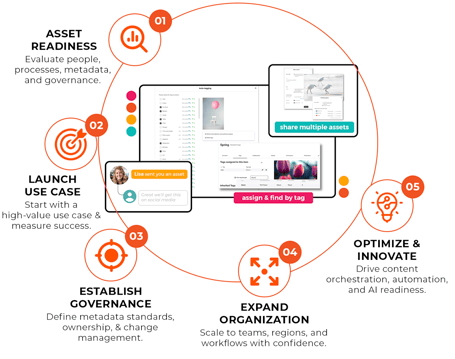
To create a digital asset management implementation project plan, build it as a phased rollout that sequences the work in a deliberate order: assess organizational readiness, launch a focused high-value use case first, govern for scale, measure operational outcomes, then expand to more teams and regions.
What Is a DAM Implementation Program Plan?
A DAM implementation project plan is a structured roadmap that aligns the full operating model — governance, metadata, workflows, permissions, rights management, adoption, integrations, and measurement — into a phased rollout. The strongest implementations treat DAM as an operational transformation, not a software deployment project.
A DAM system can technically be live within weeks. Getting teams to use it consistently takes longer.
Configuration work, such as metadata fields, permissions, integration timelines, comes together quickly enough. What vendor timelines rarely account for is what follows:
- Change management
- Stakeholder alignment
- Workflow redesign
- Metadata cleanup
- Rights validation
- Adoption planning
When that foundational work gets compressed or skipped, adoption stalls, metadata drifts, workflows stay fragmented, and the system remains technically live while content operations happen outside it.
A strong digital asset management implementation program plan treats the technical deployment as one component of a larger transformation — the governance, metadata standards, workflows, adoption, and rights work that determines whether a DAM becomes infrastructure teams rely on daily or a system they route around. That work starts well before any software configuration begins.
How Do You Assess Readiness for a DAM Implementation?
Assess readiness by evaluating whether your organization has the operating model to sustain a DAM over time, not whether it can technically configure one. The most effective implementations begin before any configuration happens, because readiness is an operational exercise, not a technical one. Also, evaluate the level of standardization vs. flexibility you want across departments and teams that will co-exist in the DAM. This is one of the most important pieces to getting the foundation right.
Before defining scope, evaluate maturity across these dimensions rather than starting from a review of digital asset management system features:
- Team maturity — whether owners and day-to-day users are in place and ready to work in the system.
- Metadata readiness — the state of naming conventions, taxonomy, and governance standards in practice.
- Governance maturity — whether ownership, decision rights, and standards exist and are enforced.
- Workflow maturity — how content moves through approvals, rights validation, localization, and distribution.
- Rights management readiness — what rights and permissions infrastructure exists, and whether it can support governed distribution at the scale the program requires.
Start by mapping how content moves today: how it is requested, reviewed, approved, distributed, and reused. Gaps in that map are where implementation plans most commonly underestimate scope. Rights structures, approval paths, localization requirements, and distribution channels are frequent sources of scope expansion once implementation begins. The goal is to see whether existing operations can support a structured rollout, and to identify those gaps before go-live so they don't compound once the system is live.
Enterprise Example of a DAM Implementation: Components for Success
A global organization may manage:
- Dozens of brands
- Hundreds of stakeholders
- Multiple regulatory environments
- Regional content teams
- Localization vendors
- Distribution channels
A global organization may manage dozens of brands, hundreds of stakeholders, multiple regulatory environments, regional content teams, localization vendors, and distribution channels. An implementation that fails to account for governance, rights management, workflow maturity, and metadata readiness often uncovers these dependencies after deployment, when remediation is more expensive.
- Metadata readiness deserves particular attention. Many organizations discover during this phase that naming conventions vary across teams, taxonomy structures are inconsistent, and governance standards exist in policy documents but not in practice. Metadata does more than power search: it governs workflow routing, rights enforcement, approval visibility, localization, and reporting. Teams that treat metadata as a naming exercise often discover post-launch that it is the control layer for the entire operating model.
These gaps do not prevent implementation, but surfacing them early lets teams address the root cause before it becomes a post-launch adoption problem. Organizations that select digital asset management software without first assessing metadata and governance maturity often find themselves reconfiguring the system before it reaches maturity — usually because workflow logic, approval routing, permission models, and rights rules were never mapped before configuration began.
- Stakeholder alignment is equally critical. Successful implementations require clarity on business objectives, rollout priorities, and long-term ownership before the first configuration decision. Alignment should include:
- Content operations leaders
- Legal and compliance
- Regional representatives
- Product teams
- Creative operations
- IT
- DAM administrators
Each of these has requirements that shape metadata design, workflow logic, permissions, and governance.
Establish executive sponsorship, a governance structure, and a DAM steering committee early, not as afterthoughts once the system is live. The steering committee should own metadata standards, taxonomy decisions, workflow governance, rights policies, adoption metrics, and the continuous improvement roadmap from day one. In our experience, organizations that fix ownership and accountability before implementation tend to see stronger adoption and more durable outcomes than those that treat governance as a post-launch concern. These readiness factors shape the organization's trajectory toward content operations maturity, not just its odds of completing an initial deployment.
Launch a High-Value DAM Use Case First
Start with a focused, high-value use case rather than a full enterprise rollout. Configuring the system for every team and workflow at once increases risk, extends timelines, and makes it harder to tell whether foundational decisions are working. When governance, metadata, workflow, and permission decisions are still unresolved, scaling to all teams at once multiplies the gaps rather than surfacing them cleanly.
Think of the first rollout phase as a pilot operating model, not a pilot technology deployment. The objective is to validate governance, metadata quality, workflow routing, rights enforcement, adoption, and reporting under real-world conditions before adding complexity.
The better approach is to pick a use case that delivers measurable business outcomes while letting teams test governance models, metadata standards, workflows, and adoption strategies in a controlled environment. The goal is to prove the operating model works — governance, approvals, rights validation, adoption, and measurement all functioning under real conditions across the content lifecycle, from intake through workflow, approval, distribution, and reporting.
Common Starting Points for Launching a High Value DAM Use Case
Common starting points for simple operations include:
- Brand asset management
- Sales enablement content
- Campaign operations
- Creative collaboration workflows
- Final asset archive and distribution
The right choice depends on where the organization has the most to gain and where a clear owner is already in place.
Criteria for a Choosing a High Value DAM Use Case for Launch
The criteria for a strong initial use case are straightforward:
- A defined set of users
- A clear content type
- Clear ownership
- Documented governance requirements
- Outcomes you can measure before launch
Early Metrics for Measuring DAM Use Case Launch Success
Relevant early metrics include:
- Reduced asset search time
- Increased reuse
- Faster campaign execution
- Higher adoption rates
Stronger operational metrics for enterprise programs add:
- Workflow cycle time
- Approval turnaround
- Metadata completeness
- Rights compliance.
These metrics do double duty: they signal success and become the proof points that secure buy-in for later phases.
When teams can see the DAM working for a specific use case — and governance and metadata standards have been validated against real workflows — momentum builds and the path to broader adoption gets clearer. “Working” is defined as: users can find assets, trust the metadata, follow governed workflows, complete approvals, validate rights, and distribute content without routing around the system. Treat the first phase as a structured learning exercise. A phased, iterative implementation approach helps organizations set accurate expectations, deliver value incrementally, and reduce the risk of a full rollout before foundational processes are stable.
What Does Effective DAM Governance Look Like at Scale?
At scale, effective DAM governance is an operating model rather than a set of policies. It keeps content, metadata, rights, workflows, permissions, and lifecycle decisions consistent as the program grows, and it assigns clear ownership and decision rights before the system goes live. Governance is often the difference between a DAM that becomes the infrastructure teams rely on daily and one that becomes an expensive storage repository.
As organizations adopt AI-powered workflows, governance matters even more. AI systems depend on permissions, metadata, approval status, rights restrictions, and workflow context to operate safely. Weak governance creates risk not only for users but for automated systems acting on enterprise content, and it blocks content orchestration: systems cannot reliably act on incomplete or inconsistent metadata, permissions, and rights.
Components of Effective Governance in Digital Asset Management
Governance is also the part of implementation most often deferred to post-launch rather than treated as a design priority. Effective governance in digital asset management means developing:
- Metadata standards
- Taxonomy structures
- Naming conventions
- Rights frameworks
- Ownership models
- Workflow and approval standards
- Compliance standards
Determine these components before the system goes live, then maintain them as the program grows. Define who is responsible for content quality, metadata, permissions, workflow administration, and lifecycle management. And define decision rights. This determines who can:
-
Change taxonomy
-
Approve new metadata fields
-
Modify workflow rules
-
Update rights policies
-
Authorize expansion to new teams or regions
Diffuse accountability erodes governance; clear ownership compounds it. A well-designed governance structure typically has three tiers:
- A high-level council. Their focus is on strategy, alignment, and standardization across departments (such as metadata schema, workflows, integrations.)
- Departmental admins. Their focus is on department-specific implementation decisions, configuration changes, and acting as a first line of support for end users
- End users. As the day-to-day users, they provide operational feedback to inform the decisions made by the high-level council and departmental admins.
How does DAM platform adoption fail?
In Forrester Consulting research commissioned by Orange Logic, 35% of 313 rich-media decision-makers named driving DAM user adoption as a challenge to achieving their DAM goals. Adoption fails when the DAM does not address end users’ existing pain points. For example, if the DAM only serves higher-level goals of consolidating systems, but isn't set up for simpler search, adoption fails even if all else remains equal. Organizations that invest in structured onboarding, internal champions, user training, and communication plans tend to see faster adoption and stronger governance compliance than those that treat training as a one-time event.
Change management research backs this up: projects with extremely effective sponsors are nearly three times more likely to meet their objectives than those with extremely ineffective sponsorship (79% vs. 27%). For organizations with structured change management practices, 59% had good or excellent change management success. Only 26% of organizations with unstructured change management processes had the same level of success. (Prosci, Best Practices in Change Management, 12th Edition, 2023). More recent research points the same way: only 32% of mid-to-senior business leaders said the last change they led achieved healthy adoption by employees, and Gartner's model predicts that when leaders routinize change, employees are three times more likely to adopt changes on time (Gartner, 2025). Executive sponsorship in a DAM implementation means more than budget approval. Sponsors should reinforce governance decisions, adoption expectations, and cross-functional accountability throughout the program.
Governance should also define how the DAM evolves. Create a mechanism for collecting user feedback, reviewing taxonomy and metadata performance, and updating standards as business requirements change. Governance review cycles should cover workflow performance, rights compliance, metadata quality, search success, and reuse rates on a defined cadence rather than informally. Well-maintained DAM governance also lays the foundation for workflow automation, rights enforcement, and AI readiness, which depend on consistent metadata and clean rights data to function at scale.
When Should You Expand a DAM Rollout?
Expand a DAM rollout when the initial use case demonstrates operational readiness, not on a calendar milestone. One of the most common mistakes in phased rollouts is advancing to the next phase before the foundation is stable, usually driven by internal pressure to onboard all teams quickly.
Operational readiness means:
-
Adoption is stable in the initial use case
-
Metadata quality is reliable
-
Workflows function as designed
-
Rights rules are enforced
-
Governance owners are active
-
Support issues are manageable.
Before onboarding additional teams, departments, or regions, evaluate adoption milestones, governance maturity, metadata consistency, workflow effectiveness, and training completion for the initial use case. If foundational processes are not working for the first group of users, expanding too soon amplifies those challenges rather than resolving them.
A governance gap that affects one team will affect ten teams at greater scale. Inconsistent metadata, unclear ownership, incomplete rights fields, broken approval workflows, and low search confidence all become more costly once scaled across departments or regions.
When the foundation is solid, DAM program management becomes a structured, lower-risk expansion exercise. Scale across additional departments, regional teams, product groups, agency partners, and new content workflows based on demonstrated success in prior phases. Each phase should also assess whether taxonomy, metadata rules, workflow logic, and permissions need to be adapted for the new team or region rather than copied wholesale; each should also have defined objectives, measurable success criteria, and governance checkpoints before the next begins.
Phased expansion also builds organizational expertise. Teams that have worked through multiple phases develop a clearer picture of which governance decisions hold at scale, where metadata standards need adjustment, and how adoption programs should be tailored for different user groups. That institutional knowledge cannot be configured into the software; it builds through sustained engagement and requires ongoing governance and content operations leadership, not just platform administration.
How Should Teams Measure DAM Success Over Time?
Measure DAM success by operational outcomes that connect system activity to business results:
- Asset reuse
- Search success
- Workflow cycle times
- Rights compliance
- Cost avoidance
Operational outcomes should be reviewed on a regular cadence, not by login counts and storage utilization. The greatest benefits of a mature program come well after implementation is complete:
- Reduced duplicate production
- Higher asset reuse
- Faster campaign execution
- Improved compliance
- Stronger reporting
- AI readiness
Useful performance indicators go beyond login counts and storage utilization. Login metrics show system access, not operational value: teams that still rely on email, shared drives, or manual approvals for real work may report high login rates while content operations happen outside the DAM.
The long-term goal is a mature content operations platform that supports governance, automation, content reuse, and reporting across the enterprise. That foundation is what lets teams move from asset storage to governed content lifecycle management, and what lets content orchestration work as designed. Organizations that reach that stage have built strong governance habits, kept a continuous improvement roadmap, and kept the DAM connected to how content actually moves through the business. The implementation project plan is where that work starts.
Build a DAM Implementation Plan That Scales With Your Organization
Successful DAM programs are designed with organizational change in mind, not just software deployment: new governance responsibilities, metadata discipline, workflow accountability, and adoption expectations that span teams, functions, and regions.
Scaling a DAM platform comes down to the right operational foundation:
- Governance that defines ownership and accountability
- Metadata and taxonomy standards that reflect how teams actually work
- Adoption programs that bring users along from the start
- A measurement framework tied to business outcomes
For organizations running complex, high-volume content operations, that foundation is also what makes content orchestration possible at scale, and what lets teams move from asset storage to governed content lifecycle management.
Orange Logic helps enterprise teams implement DAM as a governed content operations foundation by connecting assets, metadata, workflows, rights management, governance controls, integrations, and AI capabilities in one configurable system, with governance built in from day one. For example, A+E Global Media runs governed content operations at scale on Orange Logic, managing 754,125 photographs across 202 territories. Forrester named Orange Logic a Leader in The Forrester Wave™: Digital Asset Management Systems, Q1 2026, calling it "an excellent option for organizations that want to implement a comprehensive DAM system."
If you are building or scaling a content orchestration strategy and want to see what that foundation looks like in practice, let's talk.
FAQ
How Do You Prioritize Use Cases in a Digital Asset Management Implementation Project Plan?
Prioritize use cases that have:
- A defined user group
- A clear content type
- Clear ownership
- Documented governance requirements
They should also test the full operating model, not just storage and retrieval. High-priority use cases exercise metadata standards, workflows, permissions, rights validation, adoption, and reporting. Strong starting points include brand asset management, sales enablement content, and campaign operations. The best initial use case delivers demonstrable business value while letting governance models and metadata standards be tested and validated before they are applied across the broader organization.
What Should a DAM Steering Committee Be Responsible for During Implementation?
A DAM steering committee owns the decisions that keep the program aligned and unblocked. During implementation, it should:
-
Review progress against defined milestones
-
Resolve governance disputes
-
Prioritize configuration and workflow decisions
-
Maintain executive sponsorship
-
Keep the program aligned with business objectives.
It should also own metadata governance standards, taxonomy decisions, rights policies, workflow governance, adoption KPIs, and the post-launch optimization roadmap. During expansion phases, the committee should evaluate operational readiness — governance maturity, metadata consistency, and adoption rates — before approving rollout to additional teams or regions.
How Can Teams Measure DAM Adoption Beyond User Login Metrics?
Measure adoption by whether real work happens in the system, not by whether users log in. Login metrics show access, not value: a team can log in daily while its real work still runs on email, shared drives, and manual approvals. Meaningful indicators of DAM adoption include:
- Asset search success rates
- Content reuse rates
- Workflow completion rates
- Metadata compliance.
For enterprise programs, add:
- Workflow cycle time
- Approval completion rates
- Rights compliance rates
- Metadata completeness
- The percentage of assets reused before new production starts.
Tracking content velocity from request to approved distribution can also surface governance or adoption gaps worth attention.
How Long Does a DAM Implementation Take?
There is no single timeline for a DAM implementation. It depends on governance maturity, metadata readiness, integrations, workflow complexity, and organizational change requirements. A system can be technically live in weeks, but consistent adoption takes longer, which is why most enterprise implementations are phased rather than completed in a single deployment.
What Should Be Completed Before DAM Configuration Begins?
Before configuration begins, complete the readiness and alignment work that configuration depends on:
- Assess governance maturity
- Workflow readiness
- Metadata standards
- Rights management requirements
Also, confirm stakeholder ownership, adoption plans, and business objectives. Mapping this first is what prevents costly reconfiguration later.
When Is the Right Time to Expand a DAM Rollout to Additional Departments or Regions?
Expand when operational readiness is demonstrated, not when the calendar says so. Key indicators of readiness to expand a DAM rollout include:
- Strong governance compliance in the initial use case
- Metadata consistency
- High user adoption
- Resolved workflow issues
- Documented governance standards that can be applied to new teams.
Readiness also includes:
-
Administrator capacity
-
Support capacity
-
Integration readiness
-
Rights policy readiness for the new team or region
-
Training materials prepared before onboarding begins.
If foundational processes are still being resolved in the first phase, expanding early amplifies those challenges at a larger scale.
How Do Metadata Readiness and Governance Maturity Impact DAM Implementation Success?
Together they determine both how well a DAM launches and whether it keeps delivering value. Metadata readiness determines how quickly users can find, filter, and reuse assets after launch. Poor metadata structure leads to low search confidence and reduced adoption, even in a well-configured system. Governance maturity determines whether those metadata standards are maintained over time: organizations with strong governance are more likely to keep taxonomy consistent, enforce naming conventions, and adapt standards as requirements evolve. Together they also determine whether the DAM can support workflow automation, rights enforcement, reporting, and AI readiness, which are the capabilities that separate a mature content operations platform from a basic storage-and-retrieval system.