

How Publishers can create more value from original content and archives while reducing the work required for each new use.
Audiences are in more places. The work keeps multiplying.
An interview can support a web feature, a video explainer, an audio briefing, or a licensed package. The editorial possibilities are clear. The commercial decision depends on how much additional work each use requires.
For Publishers facing pressure on revenue and resources, the question is increasingly economic: How much work should the next valuable use of a piece of content require?
Reducing that work changes which opportunities a Publisher can afford to pursue. A specialist product, a new distribution relationship, or a licensing request may become viable when serving it no longer requires rebuilding the same foundation.
Three shifts are changing the publishing equation
The Reuters Institute Digital News Report 2026 illustrates the pressures behind this question.
- Distribution is moving beyond owned destinations. Across 48 surveyed markets, 54% use social and video networks for news, compared with 51% using Publishers’ websites and apps. The first encounter with a Publisher’s content increasingly depends on someone else’s platform.
- Video is central to the audience experience. Weekly online news video consumption reaches 77%. Meeting that demand adds production and delivery requirements alongside the content teams already produce.
- Trust remains fragile. Only 37% trust most news most of the time, the lowest level recorded since measurement began in 2015. As content travels further from its original presentation, maintaining source context and editorial standards becomes essential.
From these shifts, we see three connected priorities: create more value from original content, make multiplatform publishing sustainable, and preserve trust and control.
More distribution only improves the business when the Publisher captures value from it. That might mean a stronger audience relationship, demand for a paid product, advertising or licensing revenue, or a more economical way to serve an existing audience. Reach alone does not settle the investment decision.
“A Publisher may already have the material for its next paid product or licensing opportunity. The challenge is making the cost of delivering it proportionate to the value it can create.”
AI can create a clip. Can the business put it to use?
Consider an archived interview that could enrich today’s coverage. AI can help identify a relevant passage or produce a draft script. Before the material becomes a video explainer, the team still needs to establish whether it is the right source, whether the intended use is permitted, and what preparation and review are required.
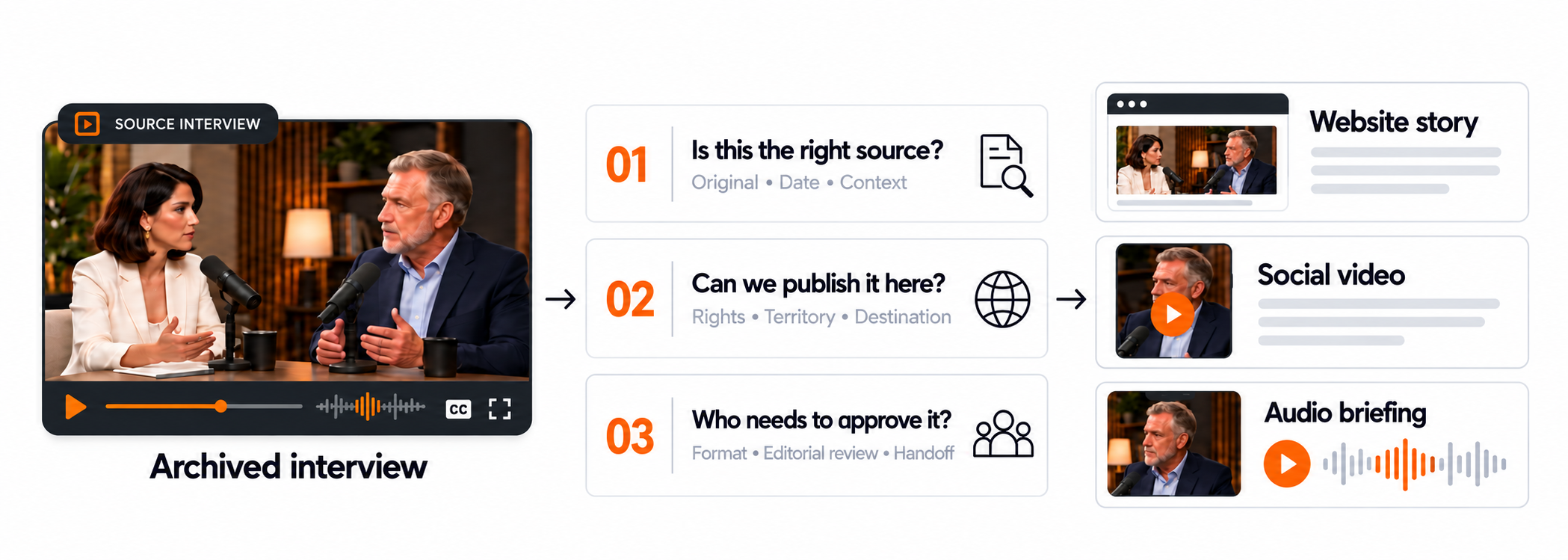
A fast creative task can sit inside a slow publishing process. An editor finds a promising excerpt but needs another team to locate the original. A rights question surfaces after editing begins. A finished version waits because the approval owner is unclear.
The practical question is: what does it actually cost to turn this interview into three approved outputs, including the time spent waiting, checking, and reworking? Measuring generation speed alone misses that larger picture. The business impact depends on the full journey from a promising source to an approved, delivered output.
Make the Publisher’s knowledge available at every step
Publishers already know a great deal about their content. Keeping that knowledge connected allows the next team to build on it.
For the interview, the recording and transcript remain linked to source details, usage conditions, and approval history. An excerpt retains its relationship to the original, giving an editor a way to check what came before and after the selected passage.

Publishers can adapt a story more efficiently when each format starts from a shared, verified source with its context and usage conditions connected. Teams can then focus on the editorial changes each audience and format requires.
The website team can develop a detailed explanation, the video team can shape an exchange for a social audience, and the audio team can prepare a briefing that makes sense without pictures.
Rights and licensing information needs a durable connection too. Structured records can associate content with ownership, agreements, permitted uses, required credits, and expiry dates. Relevant fields and stable identifiers can accompany exports, API responses, or partner packages, with access to the authoritative record for further detail. Connected destinations need processes to respond when those conditions change.
Editorial context deserves the same attention. An approved excerpt can become misleading when separated from the question that prompted it. A correction to the source may affect several later versions. Maintaining those relationships helps teams identify what needs review.
The value compounds when each use leaves the next team better informed. People spend less time reconstructing what is already known and more time deciding what will make the content useful to an audience.
A usable archive expands the commercial possibilities
This changes how Publishers can evaluate their archives. Search may reveal relevant material, but a commercial offer requires content a buyer can assess, license, and use. The work between those two points determines whether an opportunity is worth serving.
Making an archive searchable creates potential. Making it usable creates value.
How much of your archive could a commercial team confidently offer to a buyer today, with permitted uses, credits, and delivery requirements already understood?
Publishers can monetize archives through licensing and syndication, premium topic collections, anniversary editions, educational resources, or new video and audio programming. The starting point is evidence of demand for something distinctive in the collection.
Different offers require different economics. A routine request to license a photograph or interview excerpt needs a fulfillment process proportionate to the fee. A premium anniversary collection may justify substantial editorial work to select, contextualize, and package material. In both cases, having the source information and usage conditions available helps teams estimate the work and price the offer accordingly.
Archive value has two financial dimensions: incremental revenue from new uses and costs avoided through reuse. Teams may also recover capacity for higher-value work, although time saved does not automatically reduce spending. Separating those outcomes makes the business case more credible.
This is where efficiency becomes a growth strategy. A Publisher can test an offer that previously looked too expensive to assemble. Better access and preparation do not create demand, but they can lower the cost of finding out whether an opportunity deserves further investment.
Build toward liquid content while improving the business today
Liquid content in publishing is information structured as reusable components that can be assembled into experiences suited to a person’s needs or context. Those components include facts, quotations, dates, events, and supporting material. Converting a finished article into audio or video does not, by itself, create that structure.
The Reuters Institute’s Journalism, Media, and Technology Trends and Predictions 2026 report describes content adapting to a person’s context or interaction. FT Strategies explains that this also requires changes to commissioning and collaboration across editorial, product, and commercial teams. Digiday highlights unresolved questions about accuracy, audience demand, ownership, and monetization.
Publishers can make useful progress before that broader model matures. Discoverable source material, connected rights and provenance, and better handoffs deliver value now. They also provide part of the foundation for more responsive experiences, alongside the editorial structures and audience understanding those experiences require.
The investment test is practical: does this change solve a current problem and preserve useful options for the future? The immediate return should stand on its own.
Connecting content knowledge to production and delivery
AWS supports digital Publishers with cloud infrastructure, AI capabilities, storage, processing, and content delivery. Orange Logic brings those capabilities into workflows that connect content with its context, rights, and approvals.
In the interview example, that means teams can find source material alongside the information needed to evaluate it, prepare the next version, and route it for review. Integrations connect approved outputs to publishing systems and distribution partners. AI agents can assist with configured tasks and handoffs, while editorial decisions remain with the people responsible for publication.
The benefit is continuity across the work. Each team can build on the content and decisions already available, with fewer disconnected handoffs. Publishers’ editorial and product teams still determine how information is structured and how audience experiences are designed.
AWS also supports the infrastructure economics behind this process. Active production libraries and deep archives have different access requirements. Expanding video output creates processing, storage, and delivery demand. Aligning those choices with actual use helps Publishers balance accessibility, performance, and cost as they grow.
“A faster AI task can still sit inside a slow publishing process. The useful test is whether the whole journey improves: less waiting and rework, a result the team can approve, and a cost that makes the intended use worth serving.”
Revisit an opportunity that used to cost too much
Choose a recurring content type and two additional uses where there is evidence of demand. A product or partnership the team previously declined because it required too much effort is a useful place to start.
Measure the full effort required to deliver it, including waiting, handoffs, and rework. Identify which work is essential to the quality of the result and which is repeated because information or decisions are disconnected. If that repeated work were reduced, would the opportunity become worth pursuing?
Test the changes against turnaround and cost per approved, delivered output, alongside the audience or commercial result. The decision to expand should reflect both what the business can deliver and what people value enough to justify the investment.
Publishers have already invested in the content that makes them distinctive. Reducing the work required for its next valuable use gives that investment more room to earn a return.
Turn the content you already have into more opportunities
Connect content, context, rights, and workflows so your teams can reuse what you’ve already created without rebuilding the process every time.
.png?width=330&height=152&name=OL%20M%26E%20Badge%20(1).png) Orange Logic’s strategic partnership with AWS helps Publishers create more value from their content. Combining Orange Logic’s content intelligence and workflows with AWS infrastructure, AI, and delivery helps teams reuse content, preserve rights and context, and reach audiences across channels while managing costs at scale.
Orange Logic’s strategic partnership with AWS helps Publishers create more value from their content. Combining Orange Logic’s content intelligence and workflows with AWS infrastructure, AI, and delivery helps teams reuse content, preserve rights and context, and reach audiences across channels while managing costs at scale.
