%20(1).webp?width=60&height=60&name=OL%20Short%20Logo%20(2)%20(1).webp)
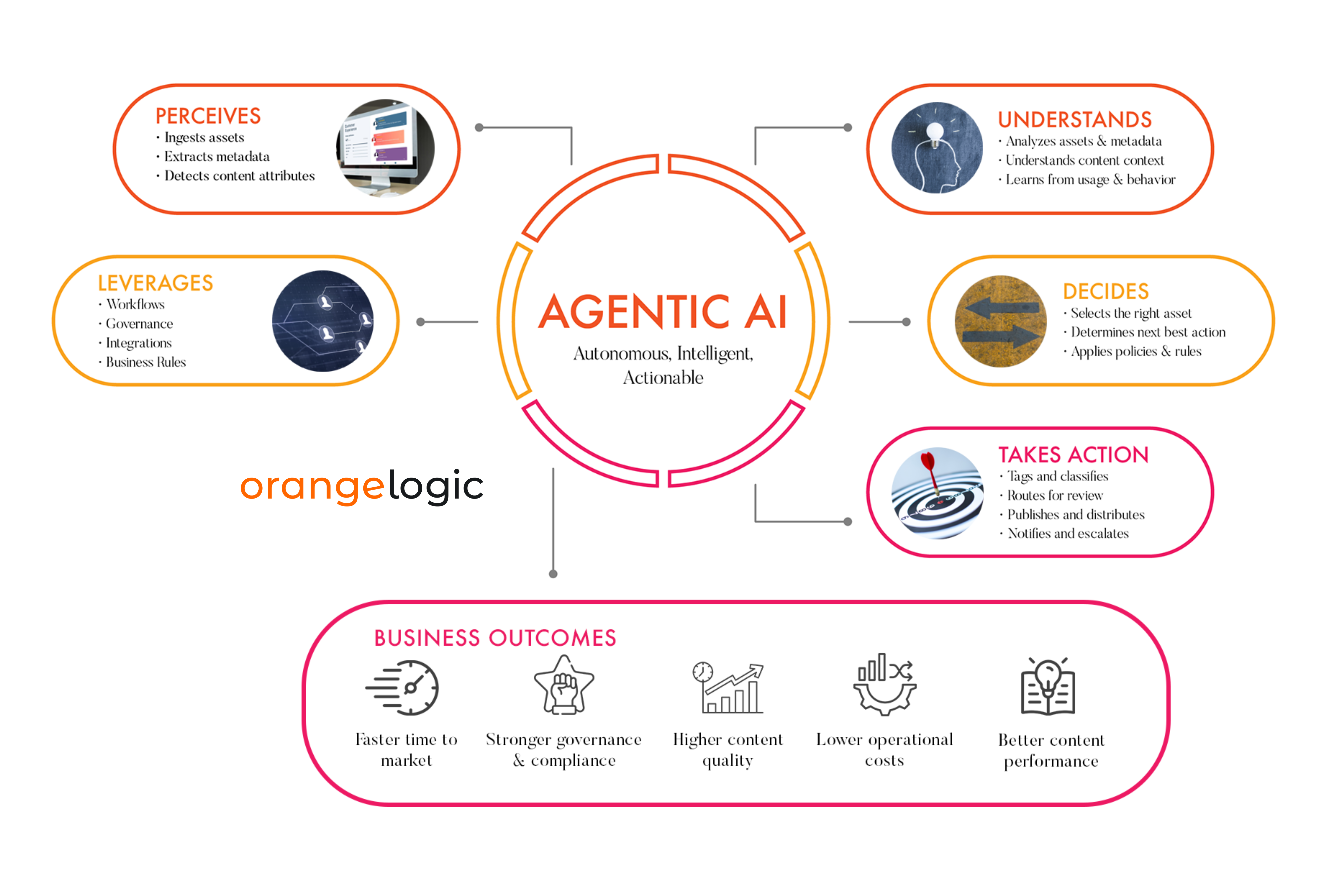
Agentic AI in asset management is not just another AI feature. Its real value comes from helping enterprise teams move content through governed workflows with more speed, context, and control.
This article covers:
- How agentic AI differs from generative AI
- Why AI needs connected assets, metadata, rights, workflows, and permissions
- Where agents can improve content operations
- How to assess agentic AI readiness
- What to look for in an enterprise DAM platform
Enterprise organizations are moving past the question of whether AI can generate more content. The more important question is whether AI can help content move through the business safely and effectively.
That shift matters for digital asset management. A DAM is no longer just a repository for approved files. At enterprise scale, it becomes the operational layer that connects assets, metadata, workflows, rights, permissions, integrations, and AI.
Without that foundation, AI tools may suggest tags or summarize content, but they cannot reliably determine whether an asset is approved, who needs to review it, where it can be used, or whether it is safe to distribute.
Generative AI helps with creating, summarizing, classifying, or searching. Agentic AI helps evaluate context and take action within defined rules, policies, and workflows.
What Is Agentic AI in Asset Management?
Agentic AI in asset management refers to AI systems that can pursue goals, evaluate context, make decisions within defined limits, and take action across connected tools and workflows.
In practical terms, agentic AI is different from generative AI. Generative AI typically responds to a prompt by producing an output, such as text, tags, summaries, images, or code. Agentic AI uses AI capabilities to plan and act. It can move work forward rather than simply assist a person at one step.
|
Generative AI |
Agentic AI |
|
Responds to a prompt |
Works toward a goal |
|
Produces suggestions |
Takes action within rules |
|
Helps with individual tasks |
Coordinates workflows |
|
Creates outputs |
Moves work forward |
In a DAM environment, a generative AI tool might suggest metadata for a new video. An agentic system could evaluate the asset against metadata standards, normalize fields, check usage rights, and route exceptions to a reviewer.
The value comes from combining AI with business context. The DAM platform holds the content, metadata, permissions, usage rules, approval status, workflow history, and operational signals agents need to act responsibly. Without that context, AI may produce useful suggestions, but it cannot reliably support governed action at enterprise scale.
For a deeper definition of agentic AI in digital asset management, it helps to think of agents as operational teammates who work within rules, not as standalone bots that make unchecked decisions.
Why Agentic AI Requires Content Orchestration
The biggest barrier to agentic AI is not intelligence. It is infrastructure.
Many organizations still manage content across disconnected systems: assets in one place, approvals in another, rights data in another, and campaign context in spreadsheets, emails, or project tools. In that environment, agents lack sufficient context to make trustworthy decisions.
If an asset’s approval status lives in one tool, rights data lives in another, and final feedback is buried in email, AI can accelerate activity without improving the underlying process. Agentic AI also introduces data quality, governance, trust, and security challenges when organizations move quickly without a clear operating model.
This is the shift from traditional DAM to content orchestration. Traditional DAM stores assets, acts as a system of record, supports search, and manages final files. Agentic content orchestration coordinates work, activates metadata, reduces manual handoffs, and helps content move safely across the business.
How Agentic AI Improves DAM Workflows
Agentic AI becomes useful when it supports real moments in the content lifecycle. The goal is not to replace creative judgment, legal review, or governance. The goal is to reduce repetitive work, route decisions more intelligently, and help teams move faster without losing control.
In an enterprise DAM workflow, agents can support:
- Ingestion and metadata: Detect asset type, campaign, region, language, and required fields; suggest tags; normalize values; and flag inconsistencies.
- Approval routing: Send assets to reviewers based on asset type, market, campaign, rights status, or workflow stage.
- Rights checks: Flag missing expiration dates, territory restrictions, talent rights issues, or assets requiring legal review.
- Duplicate detection: Identify duplicate or near-duplicate assets before teams recreate existing work.
- Localization and distribution: Start translation, resizing, adaptation, regional review, or delivery to the correct channel.
- Audit logging: Track what the agent did, what rules were applied, and where human review occurred.
This is where the question of how agentic AI can help DAM teams becomes a workflow question rather than a technology novelty. The most valuable agents are designed around real operating rules: what should be automated, what should be escalated, what requires human approval, and what should never happen without permission.
As teams evaluate reimagining DAM for the modern enterprise, the key shift is from reactive workflows to proactive systems. The DAM becomes a source of context and control that helps work move forward.
Is Your DAM Ready for Agentic AI?
Before evaluating AI capabilities, organizations should evaluate operational readiness. Agentic AI does not require a perfect DAM environment, but it does require enough structure for agents to act safely and enough governance for teams to trust the results.
Use these questions as a starting point:
- Can users and systems trust asset metadata, taxonomy, and classifications?
- Are usage restrictions centralized, structured, and enforceable?
- Are approvals, reviews, and escalation paths documented and repeatable?
- Can permissions control what users and agents can see or do?
- Can connected systems share context in real time?
- Can every AI-supported action be traced and explained?
- Can admins adapt fields, workflows, terminology, and rules without developer bottlenecks?
- Can the system support high asset volume, rich media, global teams, and high API activity?
The stronger the operational foundation, the more value agentic AI can create. The weaker the foundation, the more likely AI is to amplify existing process issues.
Where Human Oversight Still Matters
Agentic AI is powerful, but it is not a shortcut around governance. Agents can pre-check, stage, suggest, route, normalize, enrich, and flag. Humans should still make final calls where brand judgment, legal exposure, policy exceptions, reputational risk, or business strategy require accountability.
Governance should be built into the way work moves. ISO/IEC 42001 frames AI management as a structured approach for responsible development and use, including risk management, transparency, traceability, and reliability. In practice, that means permissions, auditability, escalation paths, usage rights, approval logic, and human review points should be part of the operating model from the start.
Not every content process needs an agent. Some need better rules, metadata, workflow automation, or human review. That is not a limitation. It is good governance.
What to Look for in an Enterprise DAM Platform
The right DAM platform should help teams manage work across the full content lifecycle. Assets, metadata, workflows, rights, permissions, integrations, and AI need to operate as connected parts of a single system.
For enterprise digital asset management, look for structured metadata, governed taxonomy, role-based permissions, review and approval workflows, rights and usage data, project and campaign context, rich media support, API flexibility, enterprise integrations, audit history, admin configurability, and AI extensibility inside governed workflows.
The best DAM platform is not the one with the longest feature list. It is the one that fits your scale, workflow maturity, governance requirements, integration needs, AI readiness, and adoption patterns.
When evaluating what to prioritize in digital asset management software, look beyond storage and search. The stronger question is whether the platform can help teams modernize without having to start over, connect work across systems, and prepare for governed AI over time.
How Orange Logic Supports Agentic AI in Asset Management
Orange Logic is built for enterprise teams that need more than a place to store approved files. Its strength is connecting assets, metadata, workflows, rights, permissions, integrations, and AI within a governed operating model.
That matters because agents need context before they can act safely. They need to understand what an asset is, who can use it, which workflow it belongs to, what rights apply, which systems need it, and what review steps remain.
Orange Logic supports this shift from passive DAM to content orchestration by helping teams manage content from intake and enrichment through review, approval, rights validation, localization, distribution, reuse, and archive.
Agent Studio extends this approach by enabling teams to build and manage AI agents within governed digital asset management workflows. Instead of treating AI as a disconnected experiment, teams can connect agentic automation to metadata, permissions, workflow logic, business rules, and enterprise context.
The Shift to Intelligent Asset Management
Agentic AI will not fix weak metadata, unclear ownership, disconnected rights data, or fragmented workflows on its own. But when built on a strong DAM foundation, it can help enterprise teams reduce manual work, improve governance, increase reuse, accelerate approvals, and move content through its lifecycle with greater confidence.
The next phase of asset management is not just more automation. It is better coordination between people, systems, content, and AI. Agentic AI is not replacing DAM. It is elevating DAM from a repository into the system that coordinates how content moves across the business.
When you are ready to explore how agentic AI could support your content operations, let’s talk.
FAQs About Agentic AI in Asset Management
What Is Agentic AI in Asset Management?
Agentic AI in asset management refers to AI systems that can take action across asset-related workflows within defined rules and permissions.
Instead of only generating tags or summaries, agents can evaluate metadata, route approvals, check rights, trigger localization, identify duplicates, stage assets, and escalate exceptions to people.
The goal is not to remove human oversight. It is to reduce manual coordination, improve consistency, and help teams move content through governed workflows more quickly and with greater control.
What Is the Difference Between Generative AI and Agentic AI?
Generative AI produces outputs in response to prompts. Agentic AI evaluates context and takes action toward a goal within defined business rules.
In DAM, generative AI might suggest metadata for an uploaded asset. Agentic AI might evaluate the asset, apply metadata rules, identify missing fields, route it to the right reviewer, check rights status, and prepare it for distribution once approved.
Generative AI helps create or suggest. Agentic AI helps move work forward.
Can Agentic AI Operate Without a DAM?
Agentic AI can operate without a DAM, but it is difficult to make it reliable at an enterprise scale.
Agents need structured metadata, rights data, permissions, workflow states, asset relationships, approval status, and audit history. Without a governed content system, agents are forced to act on an incomplete context.
A DAM provides the operational foundation that helps agents act safely and usefully.
How Does Agentic AI Depend on Metadata Quality and Structure in DAM Systems?
Agentic AI depends on metadata because metadata provides context.
Metadata helps the system understand what an asset is, where it belongs, who can use it, which campaign it supports, what rights apply, and what conditions should guide the next step.
Poor metadata does not just reduce search quality. It can send an agent down the wrong path. Structured fields, controlled vocabularies, validation rules, and clear ownership make agentic decisions more reliable.
What Distinguishes Agentic AI From Traditional Workflow Automation?
Traditional workflow automation follows rules set in advance. It is useful for predictable handoffs, such as sending a file to a reviewer when a status changes.
Agentic AI can evaluate a goal and choose from approved actions based on context. In content operations, that may mean checking metadata, reading a brief, validating rights data, identifying missing fields, and routing the asset to the right next step.
Workflow automation follows the map. Agentic AI can help determine which approved route makes sense in the given situation.
How Can Agentic AI Be Implemented Without Disrupting Governance?
Start with narrow use cases where the rules are clear, and the business value is measurable.
Good starting points include metadata suggestions, duplicate detection, rights flagging, approval routing, asset staging, and localization triggers.
Governance should be part of the design from the beginning. Define what the agent can access, which actions it can take, where human review is required, how exceptions are escalated, and how every action will be logged.
What Operational Risks Come From Deploying Agentic AI in Disconnected Content Systems?
Disconnected systems make it harder for agents to see the full picture.
An agent may not know whether an asset is approved, whether rights have expired, whether a newer version exists, whether product data has changed, or whether a regional restriction applies.
The result can be wrong routing, duplicated work, unreliable search results, risky distribution, or poor user trust. Agentic AI needs a connected context to act with confidence.
What Should Teams Look for in a DAM Platform for Agentic AI?
Teams should look for a DAM platform that integrates assets, metadata, workflows, permissions, rights data, integrations, and AI into a single, governed operating model.
Search is important, but it is only one part of the content lifecycle.
Teams should also evaluate configurability, adoption, admin control, scalability, rich media support, API flexibility, auditability, and whether AI is embedded in real workflows rather than added as a disconnected feature.
What Are the Best DAM Platforms for Enterprises?
The best DAM platforms for enterprises support scale, governance, adaptability, and connected workflows.
Enterprise teams often need more than a central repository. They need a system that can coordinate content creation, review, approval, reuse, rights management, delivery, and archive.
For teams evaluating agentic AI, the strongest DAM platforms also provide the context agents need to act safely: structured metadata, permissions, workflow rules, rights data, integrations, and auditability.
How Should Teams Measure Efficiency Gains From Agentic AI in Asset Management?
Measure the workflow outcomes that matter before and after deployment.
Useful metrics include:
- Time to find assets
- Approval cycle time
- Metadata completion rates
- Rights review volume
- Duplicate asset creation
- Reuse rates
- Manual handoffs removed
- Localization turnaround time
- Search success rate
- Number of escalations requiring human review
The strongest measurements connect AI activity to business process improvement. Track what the agent did, where humans intervened, and whether the process became faster, safer, or easier to manage.
A modern digital asset management system is not just the place where final assets live. It is the operational layer that helps assets, metadata, workflows, rights, and connected systems work together.
That shift matters because enterprise content rarely moves in a straight line. A campaign image might begin in a creative tool, move through review, receive usage rights, connect to product data, publish through a content management system (CMS), and later return performance insights to the team planning the next campaign. If each stage lives in a separate silo, teams lose context every time the asset moves.
A DAM platform should reduce that friction. It should help teams find assets faster, understand whether they can use them, route work to the right people, and distribute approved content without forcing manual downloads and reuploads into another content silo.
The goal is not to replace every tool in the stack. The goal is to replace unnecessary duplication, then connect the systems that still need to work together.
What a DAM Should Replace
Enterprise digital asset management becomes more valuable when it removes redundant systems and processes. The right DAM does not force every team into the same rigid workflow. It gives teams a shared operating model while preserving the flexibility they need to work in their own context.
That matters for mature DAM programs because the problem is often not a lack of tools. There are too many tools doing overlapping work. Each extra system creates another place to manage permissions, metadata, approvals, rights, and reporting.
Here are eight systems a well-configured enterprise DAM may replace or consolidate.
1. Rights Management
Digital rights management (DRM) helps teams control where, when, and how assets can be used. When rights data lives outside the asset record, teams have to check multiple systems before they can confidently publish or reuse content.
A DAM with native rights controls can bring that information closer to the work. Teams can manage usage rules, expiration dates, territories, royalties, and permissions alongside the asset itself. The NIST Cybersecurity Framework 2.0 reinforces the value of clear governance outcomes across risk, access, and accountability, which is especially relevant when assets move across teams and channels.
In practice, this means users are less likely to download an approved-looking file that carries expired or restricted rights. The DAM becomes the place where asset access, usage context, and compliance signals meet.
2. Media Asset Management for Video and Audio
Digital asset management initially focused heavily on images and documents, while media asset management (MAM) systems evolved to support video, audio, and rich media workflows. In many enterprises, that split now creates another silo.
A DAM with strong MAM functionality can manage video and audio alongside other content types. That may include large-file handling, proxy viewing, captions, time-based comments, facial recognition, transcript search, and support for production file formats.
This does not mean every DAM should replace every MAM. It means teams should question whether separate systems are still needed when video, audio, creative files, metadata, approvals, and rights can be managed within a single, governed content orchestration model.
3. Self-Service Templating Systems
Branch offices, regional teams, partners, and sales teams often need localized content. A separate templating system can help them create variants, but it can also introduce version-control issues when disconnected from approved assets and brand rules.
A DAM with built-in templating can let designers create controlled templates while giving approved users room to customize only the fields they are allowed to change. Teams can update logos, imagery, disclosures, and product visuals from the source asset record rather than chasing outdated files across separate tools.
This is one of the clearest benefits of asset management for distributed organizations. Local teams move faster, while central teams keep control over brand standards, approvals, and usage rights.
4. Digital Preservation Software
Archives, libraries, museums, media companies, and regulated enterprises often need more than simple storage. They need preservation practices that protect long-term access, integrity, and context.
A DAM with preservation capabilities can support checksums, storage policies, format strategies, audit trails, and preservation metadata. The ISO 14721:2025 OAIS reference model addresses preservation functions, including ingest, archival storage, data management, access, dissemination, and migration. The Library of Congress also describes fixity metadata as essential for determining whether digital content has changed.
For teams managing permanent or long-lived collections, the point is not only keeping files. It is preserving the information, context, and integrity needed to make those files useful over time.
5. Photo Culling and Selects Tools
Photo culling and talent approvals often happen outside the DAM. Teams upload a full shoot into a separate review tool, gather ratings or approvals, download selected files, and then upload the winning assets back into the DAM.
That workflow creates delay and risk. Files move manually, comments get lost, and the final asset record may not show the review decisions that shaped it.
Integrated approvals can keep the process closer to the asset. Photographers can upload securely, reviewers can rate or approve selects, and approved assets can move forward without leaving the governed system. This helps teams reduce duplicate handling and keep the record of decisions attached to the content.
6. Branding Software
Brand guidelines are only useful if people can find and trust them. When guidelines live in a separate brand portal, teams have to manually update logos, examples, templates, and campaign assets every time something changes.
A DAM-connected brand experience can keep guidelines and assets in sync. Teams can manage approved logos, fonts, imagery, tone guidance, and campaign examples from the same source of truth that governs the underlying files.
This is especially useful for enterprises with multiple brands, regions, or partner audiences. Public, internal, and partner-facing experiences can show different content based on permissions without creating separate unmanaged copies.
7. Project Management
Project management tools are useful for tasks, timelines, and accountability. But when the work being managed is content, the separation between project records and asset records can create gaps.
A DAM with workflow automation can connect tasks to the assets, reviewers, permissions, and metadata that define the work. Teams can assign work, route approvals, track status, and trigger next steps without relying on manual reminders or disconnected project boards.
That does not mean DAM should replace every project management tool. It means content-specific workflows should not live apart from the content itself. When they do, teams lose visibility into what changed, who approved it, and whether the final asset is ready for reuse.
8. Product or IP Archives
Product imagery, campaign assets, intellectual property, technical visuals, and historical files often end up spread across product information management (PIM) systems, archives, shared drives, and local folders. That makes reuse harder and increases the chance that teams recreate work they already own.
A DAM can serve as a product and intellectual property library by linking files to useful metadata, usage rights, and business context. Teams can filter by product line, model, region, file type, status, campaign, or rights information.
This is where it helps to define what counts as an asset in digital asset management. The broader the content lifecycle becomes, the more important it is to decide which files belong in DAM, which belong elsewhere, and how those systems should connect.
Why Replacement Alone Falls Short
Replacing redundant systems can reduce sprawl, but consolidation is not the same as orchestration. If a DAM becomes one larger place to store files while work still happens outside it, the same problems return in a new form.
The most common breakdown happens between upstream work and downstream delivery. Creative work may happen in design tools, approvals may happen in email, product context may live in PIM, and final publishing may happen in a CMS. If the DAM does not connect those stages, teams still rely on manual downloads, uploads, status checks, and one-off requests.
This is how governance gaps appear. Work-in-progress content moves outside controlled systems. Rights are checked too late. Metadata is added after the fact. Final files may never make it back into the DAM, which weakens findability and makes reuse harder.
Technical buyers should look closely at the integration layer. A DAM can centralize storage and still create bottlenecks if it cannot exchange metadata, permissions, renditions, and status updates with the systems around it.
The better test is whether the platform reduces duplication, increases reuse, improves findability, and strengthens brand governance and rights management. Those outcomes show that the DAM is operating as a source of truth, not simply as a larger repository.
What a DAM Should Connect in 2026
A modern DAM should replace avoidable overlap, then connect the tools that still play important roles in the content lifecycle. That connection layer is what turns digital asset management software into enterprise infrastructure.
The most important connections usually include CMS, PIM, creative tools, workflow systems, analytics platforms, content delivery networks (CDNs), and AI services. Each connection should preserve context. Assets should not lose metadata, rights, approval status, or usage insight as they move from one system to another.
CMS and commerce connections help teams publish approved assets without creating unmanaged copies. PIM connections help product content carry the right attributes, descriptions, and channel context. Creative tool integrations help designers and producers work where they already work, making DAM adoption more natural.
Delivery also matters. Instead of downloading files from the DAM and uploading them to another content silo, enterprises should consider distributing them through a CDN when the use case supports it. CDNs are distributed networks designed to improve availability, performance, and security by serving content closer to users.
Analytics closes the loop. When teams know which assets are used, where they appear, how often they are reused, and which versions perform, that insight can feed back into the creative engine. The DAM becomes not only a source of approved content, but a system that helps teams make better decisions about what to create next.
How DAM Supports AI Readiness Without Replacing Governance
AI readiness depends on the content foundation beneath it. If assets, metadata, rights, and permissions are scattered across disconnected systems, AI has less reliable context to work with.
This is why DAM should be viewed as part of the AI operating model, not just as a storage layer with AI features attached. AI Search, metadata enrichment, and agent-assisted workflows work better when the system understands asset relationships, usage rules, approval status, and user permissions.
Enterprise AI also needs feedback and governance. McKinsey’s 2025 State of AI survey notes that organizations are redesigning workflows, elevating governance, and mitigating risks as they deploy generative AI. MIT Sloan’s 2024 data executive agenda also points to data quality, governance, and data strategy as central concerns for AI value.
A DAM can help by giving AI a governed source of truth. It can connect structured and unstructured content, process metadata at scale, enforce permissions, and support workflows where people review and approve AI-assisted outputs.
AI improves discovery. It does not replace your metadata strategy, rights governance, or operating model. The better the foundation, the more useful and controlled the AI layer can become.
What to Look for in an Enterprise DAM Platform
The right DAM platform should reduce friction without forcing teams to start over. For many enterprises, the question is not whether they need DAM. It is whether their current DAM can support the scale, flexibility, and connected workflows their content operation now requires.
Start by evaluating whether the system gives admins enough control. Can teams adjust search filters, terminology, permissions, metadata fields, workflows, and user experiences without waiting on heavy developer support for routine changes?
Then look at the platform’s ability to support real content operations. It should manage final assets, work-in-progress collaboration, approvals, rights, delivery, reuse, and archive needs. It should also connect to the surrounding stack through APIs and integrations that support how teams already work.
Use these criteria as a starting point:
- Findability: Users can search by metadata, context, rights, relationships, and natural language where appropriate.
- Governance: Permissions, approvals, usage rules, and rights are built into the workflow.
- Flexibility: Admins can configure the system as teams, brands, and regions change.
- Reuse: Users can find approved existing content before creating something new.
- Delivery: Assets can move to downstream systems without manual file handling.
- AI readiness: AI has access to the right context, permissions, and feedback loops.
- Scale: The platform can support large files, global users, high API volume, and rich media operations.
A good enterprise DAM should make everyday work easier for users while giving administrators more visibility and control. That balance is what helps adoption last.
Rethinking DAM as Enterprise Infrastructure
A digital asset management system should replace tools and processes that create duplicate work, but replacement is only the first step. The larger opportunity is connection: assets connected to metadata, workflows connected to approvals, rights connected to delivery, and performance insight connected back to the next creative decision.
For enterprise teams, this is the shift from storage to content orchestration. DAM becomes the governed system that helps teams move faster without sacrificing control.
If your current DAM has become one more silo, it may be time to reassess what it should replace, what it should connect to, and where your content operation needs more flexibility.
Let’s talk about how to consolidate and connect your content systems without sacrificing the way your teams work.
FAQs
What Is the Best Digital Asset Management System?
The best digital asset management system is the one that fits your operating model, content volume, governance needs, and connected tech stack. For enterprise teams, that usually means a configurable DAM that supports metadata, workflows, rights, integrations, rich media, and reuse across teams and regions.
A first-time DAM buyer may prioritize basic storage, search, and sharing. A mature DAM buyer usually needs more: admin control, workflow flexibility, performance at scale, better governance, and the ability to connect DAM with upstream and downstream systems.
What Should I Use for Digital Asset Management?
Use a DAM when your team needs a governed way to organize, find, approve, reuse, and distribute digital assets. Shared drives may work for small teams, but they break down when content volume, rights, metadata, and cross-team collaboration grow.
You should also define what to save in digital asset management software. Not every file belongs in the DAM, but every high-value asset should have a clear home, owner, metadata model, rights context, and lifecycle path.
What Should I Look for in a DAM Platform?
Look for a DAM platform that supports the full content lifecycle, not only final asset storage. That includes ingest, metadata, search, permissions, review, approvals, rights, delivery, archive, integrations, and analytics.
You should also assess the extent of control administrators have. If routine changes require custom development or vendor support, the DAM may slow down as your organization changes.
What Are the Best DAM Platforms for Enterprises?
The best DAM platforms for enterprises support scale, governance, configurability, rich media, workflow automation, and integration with the broader content stack. They should help teams reduce duplication, improve reuse, protect rights, and connect content operations across departments, brands, regions, and partners.
For evaluation-stage buyers, the strongest signal is not a feature checklist alone. It is whether the DAM can become a trusted source of truth while adapting to how your teams already create, approve, distribute, and measure content.
Bring it all together with an intuitive, composable DAM platform.
OrangeDAM is an Enterprise Digital Asset Management Platform built to grow and adapt with your organization's evolving workflows.
- 130+ DAM tools
- Tailored dashboards and user-interfaces for every user
- Unlimited digital asset storage on any cloud-provider or BYOS

