
Last updated:
-
Enterprise content workflow challenges are coordination problems, not production problems.
An effective DAM workflow covers the full content lifecycle, connecting people, metadata, rights, approvals, localization, governance, and distribution within a single operational system. -
Process-based workflow design creates bottlenecks; outcome-based design creates content velocity.
Workflow orchestration, not just automation, is what enables governance, AI readiness, and content reuse at enterprise scale. -
Content reuse is one of the strongest business outcomes of workflow maturity, and one of the clearest indicators that an enterprise DAM program is operating at full scale.
What Is a DAM Workflow?
A DAM workflow is the structured process that governs how digital assets move through creation, metadata enrichment, review, approval, rights validation, localization, distribution, reuse, and archiving. Enterprise DAM workflows connect people, metadata, governance, permissions, rights management, and business systems into a coordinated operational framework.
Enterprise content teams are managing more assets, more stakeholders, and more distribution channels than most of their workflows were designed to handle. For organizations operating across brands, regions, agencies, and partner ecosystems, the constraint is rarely creative output. It is the operational structure that reliably connects content creation to governance, visibility, approvals, rights validation, localization, and distribution at scale. Gartner's DAM peer reviews reflects this shift, with enterprise evaluation criteria now extending beyond storage and retrieval to include workflow design, governance controls, workflow flexibility, metadata activation, rights management, and integration depth. That shift shows where operational friction accumulates.
Enterprise Example: A global product launch may require coordination between creative teams, product marketing, legal reviewers, localization vendors, ecommerce teams, regional stakeholders, and external agencies. Without a governed workflow, every handoff introduces delays, version confusion, rights uncertainty, and approval bottlenecks that slow time-to-market.
Why Enterprise Content Workflows Break Down
Most content workflow challenges stem from coordination failures, not creative production gaps.
Outcome-based workflow design is one of the clearest indicators of content operations maturity. Organizations that organize workflows around readiness criteria consistently reduce approval cycle times, improve governance compliance, and increase content reuse compared to organizations that optimize only for departmental process ownership.
As organizations scale across brands, regions, agencies, and partner ecosystems, content moves through email threads, shared drives, project management tools, review platforms, and disconnected approval systems. Every handoff introduces potential delays, confusion, and governance risk. According to Bain & Company, organizations that coordinate processes effectively, connect decisions, accountability, and information across stakeholders, tend to achieve better throughput than those managing fragmented handoffs. When approvals, metadata, and rights processes are disconnected, the result is operational drag at precisely the points where enterprise content operations are under the most pressure.
Across these structures, the operational pattern is recognizable: assets recreated because no one could find the original, approvals routed correctly but applied to the wrong file version, rights violations caused by manual checks skipped under deadline pressure, and chronic uncertainty about whether the asset in front of you is current and cleared for use. In high-volume environments, automated processes can distribute the wrong asset entirely because metadata or approval status was incomplete at the point of handoff. The business consequences compound: delayed campaign launches, duplicate asset creation, compliance failures discovered after distribution, and rising production costs from avoidable rework.
DAM workflow design directly affects content velocity, governance, accountability, operational scalability, and asset reuse. Organizations that deliver content efficiently are coordinating more effectively, not necessarily producing more. Faster time-to-market, higher content reuse rates, and lower per-asset production costs are outcomes of operational design, not just platform selection.
What Does an Effective DAM Workflow Look Like?
An effective DAM workflow covers the complete content lifecycle, not just the approval step. For enterprise teams using an enterprise digital asset management platform, that sequence includes intake, creative briefing, production, metadata enrichment, review, approval, rights validation, localization, legal and compliance review, distribution, content reuse and adaptation, and archiving.
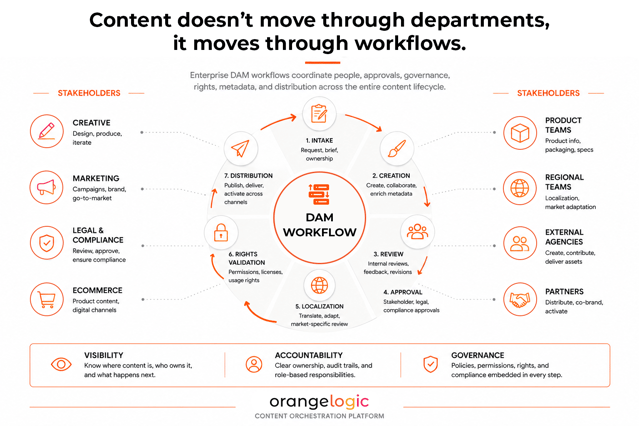
Ownership shifts at each stage: creative teams own production; marketing and product teams manage review; legal handles compliance; product and compliance teams own their respective gates; and regional teams own localization, with agencies and external partners participating across multiple stages. DAM workflow automation connects these ownership transitions through configured routing and automated handoffs, so work progresses without constant manual follow-up. That distinction matters: workflow automation connects individual handoff steps; workflow orchestration coordinates the full operational system those steps belong to.
Modern DAM workflows coordinate people, approvals, metadata, rights management, governance policies, distribution channels, and business processes into one operational framework. Enterprise workflows rarely end inside the DAM: distribution connects to CMS, PIM, eCommerce platforms, and analytics systems, making downstream integrations part of the workflow design, not an afterthought. The goal is to move content through the business efficiently and responsibly, which requires more than routing files between approval stages.
Why Most DAM Workflows Are Designed Around Process Instead of Outcomes
Many organizations build workflows around departmental ownership rather than content readiness. Marketing owns its approval steps. Legal owns its review gate. Each department manages its piece of the process, with no single owner accountable for the content's movement across the full lifecycle. The structural consequence is predictable: the same asset reviewed by multiple teams for overlapping reasons, manual follow-up required at every departmental boundary, and workflows that widen under operational pressure rather than adapt to it.
That structure produces duplicate reviews, redundant approvals, excessive handoffs, and slow delivery. Effective content operations treat content readiness as the organizing principle for workflows, rather than building approval sequences around departmental ownership. Readiness criteria such as approved, rights-cleared, localized, metadata-complete, and distribution-authorized replace departmental sign-off sequences as the checkpoints that determine where content moves next.
Outcome-based design asks what must be true for an asset to be ready for distribution, rather than which department needs to sign off next. That reorientation surfaces where delays accumulate and where governance gaps form. DAM governance policies connect governance requirements to content decisions across the lifecycle, keeping compliance aligned with business needs as workflows evolve. Governance in this context extends beyond compliance to include permissions management, rights controls, approval authority configuration, AI governance guardrails, and lifecycle rules that keep the right people accountable for the right content at each stage. Workflows that can't adapt become the operational constraints they were designed to prevent.
How Can Teams Maintain Visibility and Accountability at Scale?
Workflow visibility rarely gets the same design attention as automation, but it shapes governance as much as any other capability. Visibility is often the prerequisite for operational improvement: teams cannot reduce approval cycle times, increase asset reuse, or address bottlenecks in a workflow they cannot see. As content moves across departments, agencies, regional teams, and external partners, teams lose track of where assets are, who owns the next action, which approvals are outstanding, and what is causing delays.
Unclear content status is a governance problem. When teams don't know which version is approved or which rights have been cleared, they fill the gaps with assumptions that lead to off-brand assets in the market, expired content reused without rights clearance, and compliance failures discovered after distribution. When asset status, permissions, or rights context is unclear at the point of handoff, AI-assisted processes face the same limitation: automated routing, recommendations, and distribution staging cannot operate reliably without a trustworthy content state.
Effective DAM workflows address this through audit trails, approval histories, activity logs, role-based permissions, and rights validation checkpoints. The NISO metadata primer identifies administrative, descriptive, technical, rights, and structural metadata as foundational for reliably managing digital content over time. Governed DAM metadata functions as the operational context layer that makes workflow decisions, governance checks, rights validation, reporting queries, and AI actions possible. Enterprise teams that add metadata as a final step rather than embedding it throughout the workflow consistently find it limits the outcomes the DAM can deliver.
Creative approval vs DAM draws a key distinction: standalone review tools track feedback, whereas governed DAM workflows make approval an enforced asset state linked to metadata, version history, rights context, and distribution permissions. The Instacart DAM case study shows how one enterprise team redesigned its content workflow to reduce production delays across a high-volume operation, gaining visibility into asset status and approval progress across a fast-moving content supply chain and reducing the coordination overhead that had been slowing delivery.
For Creative Operations and Marketing Operations leaders, workflow visibility must also generate insight. Approval cycle time, throughput rates, asset reuse frequency, bottleneck location, and compliance performance are all measurable when the workflow produces structured operational data. That data makes visibility an operational input, not just a status dashboard.
Content Orchestration Requires Workflow Orchestration
Most DAM platforms are optimized for asset storage and retrieval. For enterprise teams managing a full content supply chain that spans assets, metadata, workflows, rights, governance, approvals, and distribution across brands, regions, partners, and connected systems, storage and retrieval is an insufficient operational model. Modern enterprise content operations require a connected system that moves assets through governance, approvals, localization, digital rights management, metadata enrichment, integrations, and distribution as a coordinated whole.
Workflow automation handles individual tasks: routing an asset, triggering a notification, and applying a metadata template. Real-world examples include sending a localization request when a rights check clears, triggering a CMS distribution action when all approval conditions are met, or flagging an AI-generated metadata recommendation for review before a rights-sensitive asset moves to distribution. Workflow orchestration connects those tasks into a system in which each action depends on and informs the next, with assets, metadata, permissions, governance policies, business rules, and distribution channels operating in coordination rather than in isolation.
Forrester's DAM market analysis frames this as the transition from DAM as a system of record to DAM as a system of action, one that actively participates in content operations rather than passively storing finished assets. Orange Logic is built around that transition: enterprise DAM with orchestration capabilities built into the platform architecture, and positioned not as a DAM alternative but as what enterprise DAM becomes when it is built to support the full content supply chain.
Orange Logic's approach to content and workflow orchestration connects creative operations DAM workflows directly to metadata management, governance controls, rights management, permissions, and integrations. This includes metadata-driven workflow routing, rights-aware automation, AI governance guardrails, and cross-system orchestration across CMS, PIM, eCommerce, and analytics platforms, connecting the full content supply chain through one operational system.
For AI to add value in content operations, it needs trusted metadata, governed permissions, and a reliable content state. IBM's AI governance overview identifies data accountability and operational governance as prerequisites for AI to produce reliable outcomes at scale, both of which a well-designed DAM workflow helps establish. For enterprise content operations, AI readiness is as much a workflow maturity question as a model capability question: metadata quality, rights governance, permissions architecture, and content state reliability determine whether AI can act confidently or only suggest cautiously.
Agentic AI increases the importance of workflow orchestration. AI agents need access to workflow status, approval history, permissions, rights restrictions, metadata completeness, and distribution eligibility before they can safely take action. Workflow orchestration provides the operational context required for AI systems to participate in governed content operations rather than isolated automation tasks.
DAM Workflow Design Is an Operational Advantage
The most effective DAM workflows align people, content, governance policies, metadata, rights management, and business rules into a system that scales with the organization. The DAM benefits of getting workflow design right are concrete: faster content velocity, stronger governance, higher asset reuse, reduced rework, faster campaign launch cycles, lower per-asset production costs, improved time-to-market, and more effective collaboration across internal teams and external partners.
For teams assessing the Orange Logic DAM platform, workflow design should be a central evaluation criterion. A platform's ability to support configurable workflows, governance depth, and orchestration across systems is more predictive of long-term operational performance than storage capacity or search speed alone. A DAM platform built for enterprise content operations needs to support the full lifecycle, including project management in DAM that connects production planning to the asset governance layer. Digital asset management software evaluated only on storage and search features will miss the capability that determines whether enterprise content supply chains and content operations scale effectively.
For enterprise teams building governed content operations at scale, connect with Orange Logic to discuss workflow design, content orchestration, and AI readiness across brands, regions, departments, and external partners.
FAQs
How Do Enterprise Teams Manage Creative Workflows Across Multiple Departments?
Enterprise teams manage cross-departmental creative workflows by integrating review, approval, metadata, rights, and distribution into a single governed content lifecycle. When departments own disconnected workflow stages, approvals become redundant, and asset status becomes unclear. A DAM platform that routes work across creative, marketing, legal, regional, and external teams through configured handoffs reduces manual coordination and improves visibility into what is approved and ready for distribution. Governance, including permissions management, rights controls, and configurable approval authority, should be enforced at the workflow level, not checked manually at the point of use.
What Should a DAM Workflow Include from Content Intake to Final Delivery?
Production, metadata enrichment, review, approval, rights validation, localization, legal review, distribution, content reuse and adaptation, and archiving. Ownership at each stage should be clearly defined, with automated routing connecting handoffs between teams. Metadata, governance controls, and rights context should travel with the asset throughout, not be added only after approval is complete. Performance measurement, specifically tracking how quickly content moves through each stage and where cycle times lengthen, should be treated as a design requirement, not a separate reporting function.
What Project Management Workflow Tools Support Enterprise Content Operations?
Project management capabilities support enterprise content operations best when connected to the asset governance layer rather than running in a separate system. DAM platforms with integrated planning and task management give operations leaders visibility from initial briefing through final distribution, with governance requirements and approval status tracked within the same environment rather than across disconnected tools. When project planning, asset management, governance, and workflows share the same operational context, teams spend less time reconciling information across systems and more time moving work forward.
How Can Review and Approval Software Improve Visibility in Content Workflows?
Review and approval software improves visibility by connecting approval decisions to asset state, metadata, version history, permissions, and rights context, not just a sign-off record. Standalone tools track feedback; governed DAM workflows make approval an enforced condition that shapes what the system allows next, including access permissions, distribution eligibility, and reuse rules. This removes the ambiguity that leads teams to manually verify asset status before each use. Workflow analytics and bottleneck reporting extend visibility further: teams can measure approval cycle times, track where reviews consistently slow down, and use that data to improve workflow design based on actual operational performance.
Why Is Workflow Design Important in Enterprise DAM?
Workflow design determines how efficiently content moves through the organization. Well-designed workflows improve visibility, governance, content velocity, asset reuse, and operational scalability.
What Is the Difference Between Workflow Automation and Workflow Orchestration?
Workflow automation handles individual tasks: routing an asset, sending a notification, and applying a metadata template. Workflow orchestration connects those tasks into a system where each action depends on and informs the next. Orchestration aligns assets, metadata, permissions, governance controls, rights management, integrations, and distribution channels into a coordinated operational framework rather than a sequence of independent automated steps.
How Does Workflow Orchestration Support AI?
AI systems require workflow context, metadata, permissions, approval status, and rights information to make reliable decisions. Workflow orchestration provides the governed operational framework AI depends on.
How Does Content Orchestration Improve DAM Workflows?
Content orchestration improves DAM workflows by connecting asset movement, governance controls, approvals, localization, rights management, metadata, and distribution into a single coordinated system. Without orchestration, teams manage these elements separately, creating handoff delays, governance gaps, and duplicate work. With orchestration, each workflow stage informs the next, so content moves through the lifecycle with consistent governance and fewer manual interventions. This is the foundation of enterprise content supply chain management: not point automation, but full coordination of assets, metadata, rights, approvals, governance, and downstream distribution into one operational system.